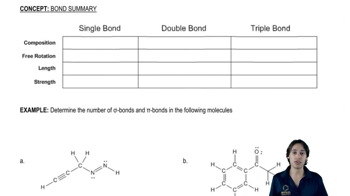
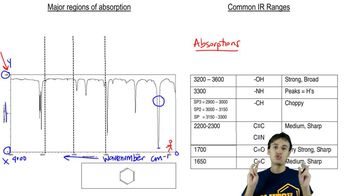
There are three carbon–oxygen bonds in methyl acetate. a. What are their relative bond lengths? b. What are the relative infrared (IR) stretching frequencies of these bonds?
Verified step by step guidance
1
Identify the three carbon–oxygen bonds in methyl acetate: (1) the C=O bond in the ester group, (2) the C–O bond between the carbonyl carbon and the oxygen in the ester group, and (3) the C–O bond between the oxygen and the methyl group.
For part (a), compare the bond lengths: The C=O bond is a double bond and will be the shortest due to its higher bond order. The C–O bond in the ester group is a single bond but is slightly shorter than a typical single bond due to resonance. The C–O bond to the methyl group is a typical single bond and will be the longest.
For part (b), analyze the IR stretching frequencies: The C=O bond will have the highest stretching frequency because it is a double bond and has a stronger bond. The C–O bond in the ester group will have a lower stretching frequency than the C=O bond but higher than the C–O bond to the methyl group. The C–O bond to the methyl group will have the lowest stretching frequency as it is a typical single bond.
Explain the relationship between bond strength and IR stretching frequency: Stronger bonds (e.g., double bonds) require more energy to stretch, leading to higher IR frequencies. Weaker bonds (e.g., single bonds) require less energy, resulting in lower IR frequencies.
Summarize the trends: The bond length order is C=O < C–O (ester group) < C–O (methyl group), and the IR stretching frequency order is C=O > C–O (ester group) > C–O (methyl group).
Verified video answer for a similar problem:
This video solution was recommended by our tutors as helpful for the problem above
Video duration:
4m
Play a video:
0 Comments
Key Concepts
Here are the essential concepts you must grasp in order to answer the question correctly.
Bond Lengths
Bond lengths refer to the distance between the nuclei of two bonded atoms. In organic molecules, bond lengths can vary based on the types of atoms involved and their hybridization states. For carbon-oxygen bonds, the bond length is influenced by factors such as the presence of double bonds or resonance structures, which can shorten the bond due to increased electron sharing.
Infrared spectroscopy is a technique used to identify molecular structures by measuring the absorption of infrared light, which causes molecular vibrations. Different types of bonds absorb IR radiation at characteristic frequencies, allowing for the identification of functional groups. The stretching frequencies of carbon-oxygen bonds can vary based on their hybridization and the molecular environment.
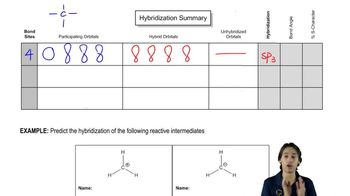
Hybridization is the concept of mixing atomic orbitals to form new hybrid orbitals that can accommodate bonding in molecules. In methyl acetate, the carbon atoms are typically sp3 hybridized, while the carbonyl carbon is sp2 hybridized. This affects both the bond lengths and the stretching frequencies of the carbon-oxygen bonds, as sp2 hybridized bonds are generally shorter and have higher stretching frequencies compared to sp3 hybridized bonds.