For each of the given species: a. Draw its Lewis structure. b. Describe the orbitals used by each carbon atom in bonding and indicate the approximate bond angles. 4. H2CO3
Verified step by step guidance
1
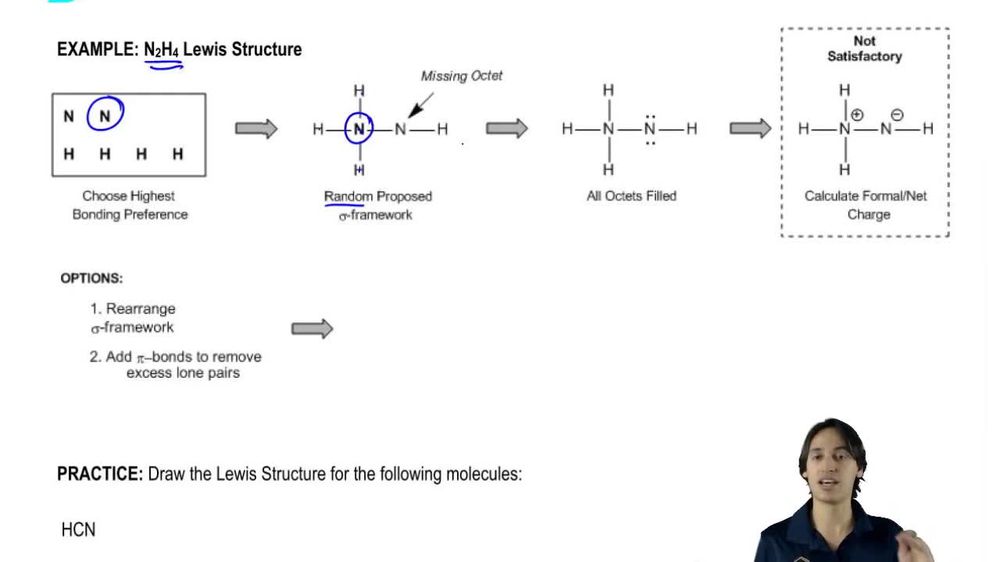
Step 1: Draw the Lewis structure for H₂CO₃ (carbonic acid). Start by identifying the central atom, which is carbon. Carbon is bonded to two hydroxyl groups (-OH) and one oxygen atom via a double bond. Distribute the valence electrons to satisfy the octet rule for each atom, ensuring that hydrogen has only two electrons.
Step 2: Assign formal charges to each atom in the structure to confirm that the most stable resonance structure is drawn. Ensure that the sum of the formal charges equals zero, as H₂CO₃ is a neutral molecule.
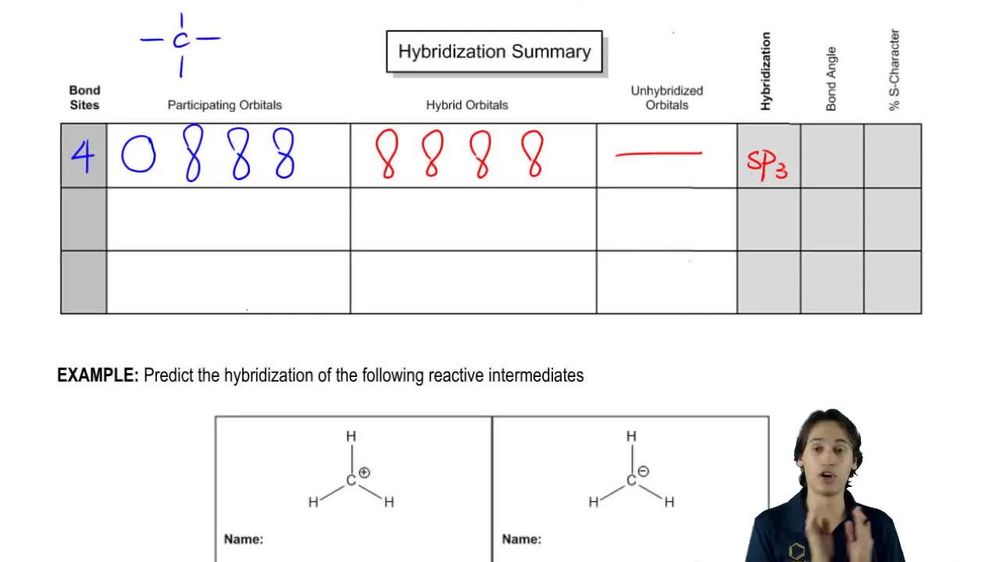
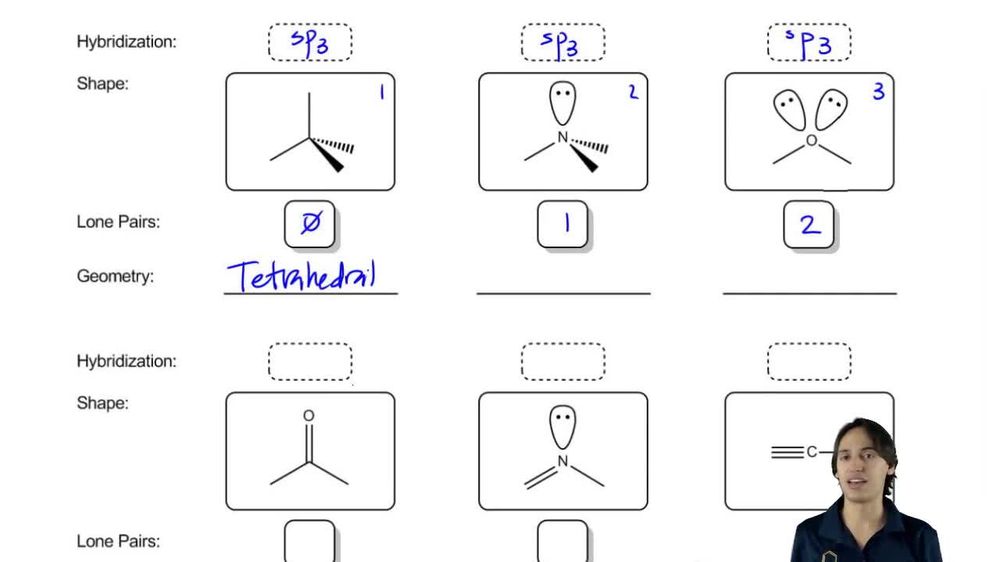
Step 3: Analyze the hybridization of the carbon atom. The carbon atom in H₂CO₃ forms three sigma bonds (two single bonds to oxygen atoms in the hydroxyl groups and one double bond to the oxygen atom). This indicates that the carbon atom is sp² hybridized.
Step 4: Determine the geometry around the carbon atom. Since the carbon atom is sp² hybridized, the molecular geometry around it is trigonal planar. The approximate bond angles are 120°.
Step 5: Describe the orbitals used in bonding. The carbon atom uses sp² hybrid orbitals to form sigma bonds with the oxygen atoms and hydrogen atoms. The unhybridized p orbital on carbon overlaps with a p orbital on the double-bonded oxygen to form a π bond.
Verified video answer for a similar problem:
This video solution was recommended by our tutors as helpful for the problem above
Video duration:
6m
Play a video:
0 Comments
Key Concepts
Here are the essential concepts you must grasp in order to answer the question correctly.
Lewis Structures
Lewis structures are diagrams that represent the bonding between atoms in a molecule and the lone pairs of electrons that may exist. They use dots to represent valence electrons and lines to represent bonds between atoms. Understanding how to draw Lewis structures is essential for visualizing molecular geometry and predicting the behavior of molecules in chemical reactions.
Hybridization is the concept of mixing atomic orbitals to form new hybrid orbitals that are suitable for the pairing of electrons to form chemical bonds. In the case of carbon, it can undergo sp3, sp2, or sp hybridization depending on the number of bonds it forms. This concept is crucial for determining the geometry of the molecule and the types of bonds present.
Molecular geometry refers to the three-dimensional arrangement of atoms in a molecule, which influences its physical and chemical properties. The bond angles are determined by the hybridization of the central atom and the repulsion between electron pairs. For H2CO3, understanding its geometry helps predict the bond angles, which are approximately 120 degrees for sp2 hybridized carbon atoms.