Textbook Question
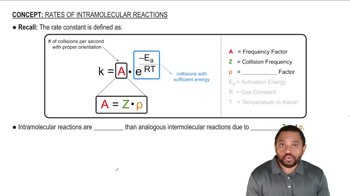
From the Arrhenius equation, predict how
b. increasing the temperature affects the rate constant for a reaction.
1119
views

 Bruice 8th EditionCh. 5 - Alkenes: Structure, Nomenclature, and an Introduction to Reactivity • Thermodynamics and KineticsProblem 34a,b
 Verified step by step guidance
 02:19
02:19
 2:29
2:29 11:40
11:40From the Arrhenius equation, predict how
b. increasing the temperature affects the rate constant for a reaction.
From the Arrhenius equation, predict how
a. increasing the experimental activation energy affects the rate constant for a reaction.
Draw a reaction coordinate diagram for the following reaction in which C is the most stable and B the least stable of the three species and the transition state going from A to B is more stable than the transition state going from B to C:
a. How many intermediates are there?
b. How many transition states are there?
c. Which step has the greater rate constant in the forward direction?
d. Which step has the greater rate constant in the reverse direction?
The rate constant for a reaction can be increased by ______ the stability of the reactant or by ______ the stability of the transition state.
Draw a reaction coordinate diagram for a two-step reaction in which the first step is endergonic, the second step is exergonic, and the overall reaction is endergonic. Label the reactants, products, intermediates, and transition states.
a. Which step in the reaction coordinate diagram shown here has the greatest free energy of activation in the forward direction?
b. Is the first-formed intermediate more apt to revert to reactants or go on to form products?
c. Which step is the rate-determining step of the reaction?
<IMAGE>