Ch. 7 - The Reactions of Alkynes • An Introduction to Multistep Synthesis
Bruice - Organic Chemistry 8th Edition
Bruice8th EditionOrganic ChemistryISBN: 9780135213711Not the one you use?Change textbook
Chapter 8, Problem 39c

What is the major product of the reaction of 1 mol of propyne with each of the following reagents?
c. Br2 (1 mol)/CH2Cl2

Verified step by step guidance
1
Identify the structure of propyne (CH≡C-CH3), which is an alkyne with a terminal triple bond.
Understand that Br2 in CH2Cl2 is a halogenation reagent that reacts with alkynes to add bromine atoms across the triple bond.
Since 1 mol of Br2 is used, only one equivalent of bromine will react with the alkyne, converting the triple bond into a double bond. This is a stereoselective reaction, typically resulting in an anti-addition of bromine atoms.
Draw the intermediate product, which will be a trans-dibromoalkene (CHBr=CHBr-CH3). The double bond remains in the molecule, and the bromine atoms are added to opposite sides of the double bond.
Verify the major product by considering the regioselectivity and stereoselectivity of the reaction. The major product will be the trans isomer of 1,2-dibromo-1-propene.

Verified video answer for a similar problem:

This video solution was recommended by our tutors as helpful for the problem above.
Video duration:
6m
Was this helpful?

Key Concepts

Here are the essential concepts you must grasp in order to answer the question correctly.

Alkyne Reactivity

Alkynes, such as propyne, are unsaturated hydrocarbons containing a carbon-carbon triple bond. This triple bond makes them highly reactive, particularly in electrophilic addition reactions. Understanding how alkynes react with halogens is crucial for predicting the products of such reactions.
Recommended video:
Guided course
09:11
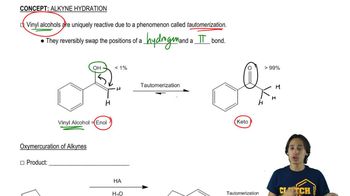
Alkyne Hydration

Electrophilic Addition

Electrophilic addition is a fundamental reaction mechanism in organic chemistry where an electrophile reacts with a nucleophile, leading to the formation of a more saturated product. In the case of propyne reacting with Br2, the bromine molecule acts as an electrophile, adding across the triple bond and resulting in a dibrominated alkane.
Recommended video:
Guided course
09:23
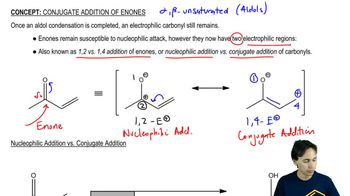
1,2 vs 1,4 Addition

Regioselectivity

Regioselectivity refers to the preference of a chemical reaction to yield one structural isomer over others when multiple products are possible. In the reaction of propyne with Br2, the regioselectivity can influence which carbon atom the bromine atoms add to, affecting the final product's structure and properties.
Recommended video:
Guided course
05:09
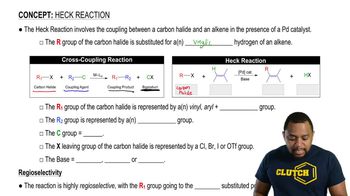
Heck Reaction