a. Describe three ways the following reaction can be carried out:
Verified step by step guidance
1
Step 1: Analyze the reaction. The starting material is an aromatic ketone (acetophenone derivative), and the product is an alkylated aromatic compound. This suggests that the reaction involves the reduction of the carbonyl group followed by alkylation.
Step 2: Method 1 - Use Clemmensen reduction. The Clemmensen reduction involves treating the ketone with zinc amalgam (Zn(Hg)) and concentrated hydrochloric acid (HCl). This reduces the carbonyl group to a methylene (-CH2-) group, followed by Friedel-Crafts alkylation using an alkyl halide and a Lewis acid catalyst like AlCl3.
Step 3: Method 2 - Use Wolff-Kishner reduction. The Wolff-Kishner reduction involves treating the ketone with hydrazine (N2H4) and a strong base like KOH under high heat. This reduces the carbonyl group to a methylene (-CH2-) group. After reduction, Friedel-Crafts alkylation can be performed using an alkyl halide and a Lewis acid catalyst.
Step 4: Method 3 - Direct alkylation after reduction. First, reduce the ketone using catalytic hydrogenation (H2 gas with a metal catalyst like Pd/C or Ni) to convert the carbonyl group to a methylene (-CH2-) group. Then, perform Friedel-Crafts alkylation using an alkyl halide and a Lewis acid catalyst.
Step 5: Summarize the reaction pathways. All three methods involve reducing the ketone to a methylene group followed by Friedel-Crafts alkylation to introduce the alkyl chain onto the aromatic ring. The choice of method depends on the reagents available and reaction conditions.
Verified video answer for a similar problem:
This video solution was recommended by our tutors as helpful for the problem above
Video duration:
4m
Play a video:
0 Comments
Key Concepts
Here are the essential concepts you must grasp in order to answer the question correctly.
Electrophilic Aromatic Substitution (EAS)
Electrophilic Aromatic Substitution is a fundamental reaction in organic chemistry where an electrophile replaces a hydrogen atom on an aromatic ring. This process is crucial for synthesizing various aromatic compounds and involves the formation of a sigma complex, where the aromaticity is temporarily lost. Understanding the mechanism and the role of the electrophile is essential for predicting the outcome of the reaction.
Retrosynthetic analysis is a strategy used in organic synthesis to deconstruct a target molecule into simpler precursor structures. This approach helps chemists identify potential synthetic routes by working backward from the desired product. It is particularly useful in planning multi-step syntheses and understanding how different reactions can be combined to achieve complex molecules.
The choice of reaction conditions and reagents significantly influences the outcome of organic reactions. Factors such as temperature, solvent, and the presence of catalysts can affect reaction rates and selectivity. In the context of EAS, different electrophiles and conditions can lead to varying substitution patterns on the aromatic ring, making it essential to understand how these variables interact in a synthetic pathway.

 4:54 minutes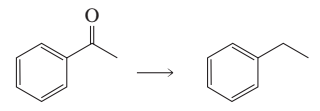
 Verified step by step guidance
 03:07
03:07