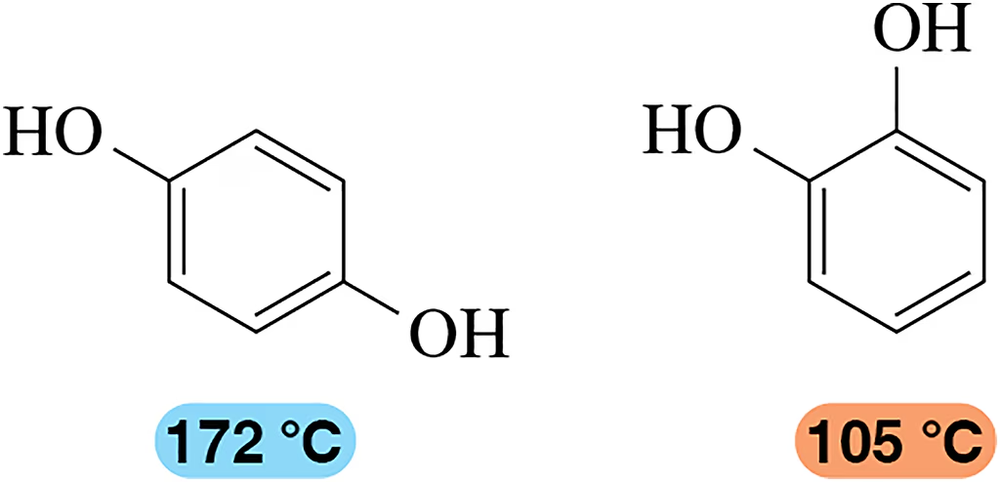
Rationalize the fact that 1,4-dihydroxybenzene melts at a significantly higher temperature than 1,2-diydroxybenzene.
Verified step by step guidance
1
Identify the two compounds: 1,4-dihydroxybenzene (para-dihydroxybenzene) and 1,2-dihydroxybenzene (ortho-dihydroxybenzene). Note their melting points: 172°C for 1,4-dihydroxybenzene and 105°C for 1,2-dihydroxybenzene.
Consider the molecular structure of each compound. In 1,4-dihydroxybenzene, the hydroxyl groups are positioned opposite each other on the benzene ring, while in 1,2-dihydroxybenzene, the hydroxyl groups are adjacent.
Analyze the potential for hydrogen bonding. In 1,4-dihydroxybenzene, the hydroxyl groups can form intermolecular hydrogen bonds with other molecules, leading to a more stable and tightly packed crystal lattice.
In contrast, 1,2-dihydroxybenzene can form intramolecular hydrogen bonds between the adjacent hydroxyl groups, which reduces the ability to form strong intermolecular hydrogen bonds, resulting in a less stable crystal lattice.
Conclude that the stronger intermolecular hydrogen bonding in 1,4-dihydroxybenzene leads to a higher melting point compared to 1,2-dihydroxybenzene, where intramolecular hydrogen bonding predominates.
Verified video answer for a similar problem:
This video solution was recommended by our tutors as helpful for the problem above
Play a video:
0 Comments
Key Concepts
Here are the essential concepts you must grasp in order to answer the question correctly.
Hydrogen Bonding
Hydrogen bonding is a strong type of dipole-dipole interaction that occurs when a hydrogen atom covalently bonded to a highly electronegative atom, like oxygen, interacts with another electronegative atom. In the case of 1,4-dihydroxybenzene, the hydroxyl groups are positioned para to each other, allowing for effective hydrogen bonding between molecules, which significantly increases the melting point.
Molecular structure refers to the arrangement of atoms within a molecule, which can greatly influence its physical properties. 1,4-Dihydroxybenzene (para) has a symmetrical structure that facilitates stronger intermolecular interactions compared to 1,2-dihydroxybenzene (ortho), where steric hindrance can disrupt effective packing and bonding, leading to a lower melting point.
The melting point of a substance is the temperature at which it transitions from solid to liquid, heavily influenced by the strength of intermolecular forces. Stronger intermolecular forces, such as hydrogen bonds in 1,4-dihydroxybenzene, result in a higher melting point compared to weaker forces in 1,2-dihydroxybenzene, which experiences more steric hindrance and less effective packing.

 Verified step by step guidance
 00:48
00:48