Ch. 17 - Reactions of Aromatic Compounds
Wade - Organic Chemistry 9th Edition
Wade9th EditionOrganic ChemistryISBN: 9780135213728Not the one you use?Change textbook
Chapter 17, Problem 41c

Predict the products formed when m-cresol (m-methylphenol) reacts with
(c) bromine in CCl4 in the dark

Verified step by step guidance
1
Identify the structure of m-cresol (m-methylphenol). It consists of a benzene ring with a hydroxyl (-OH) group and a methyl (-CH₃) group in the meta position relative to each other.
Understand the reaction conditions: Bromine (Br₂) in CCl₄ (carbon tetrachloride) in the dark. This indicates that the reaction will proceed via electrophilic aromatic substitution, as there is no light or catalyst to promote a radical reaction.
Recognize the directing effects of the substituents on the benzene ring. The hydroxyl (-OH) group is an activating, ortho/para-directing group, while the methyl (-CH₃) group is also an activating, ortho/para-directing group. However, since the groups are in the meta position relative to each other, their directing effects will influence different positions on the ring.
Determine the positions on the benzene ring where bromine will substitute. The -OH group will direct bromine to the ortho and para positions relative to itself, while the -CH₃ group will direct bromine to the ortho and para positions relative to itself. The overlap of these directing effects will determine the most likely substitution sites.
Draw the possible products based on the substitution pattern. Consider steric hindrance and electronic effects to predict the major product(s). Ensure that the bromine atom is added to the position(s) that align with the combined directing effects of the -OH and -CH₃ groups.

Verified video answer for a similar problem:

This video solution was recommended by our tutors as helpful for the problem above.
Video duration:
3m
Was this helpful?

Key Concepts

Here are the essential concepts you must grasp in order to answer the question correctly.

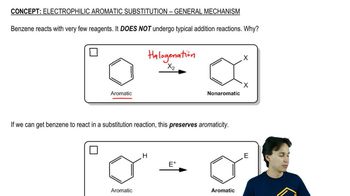
Electrophilic Aromatic Substitution

Electrophilic aromatic substitution (EAS) is a fundamental reaction in organic chemistry where an electrophile replaces a hydrogen atom on an aromatic ring. In the case of m-cresol, the presence of the methyl group and the hydroxyl group influences the reactivity and orientation of the substitution, typically directing electrophiles to the ortho and para positions relative to the substituents.
Recommended video:

Bromination of Aromatic Compounds

Bromination is a specific type of electrophilic aromatic substitution where bromine acts as the electrophile. In the presence of a non-polar solvent like CCl4, bromine can react with m-cresol to form brominated products. The reaction typically occurs at the positions on the aromatic ring that are most activated by the existing substituents.
Recommended video:
Guided course
00:54
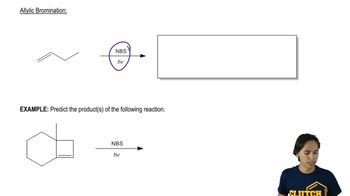
Mechanism of Allylic Bromination.

Influence of Substituents on Reactivity

The reactivity of aromatic compounds in electrophilic substitution reactions is significantly influenced by the nature of substituents already present on the ring. In m-cresol, the hydroxyl group is a strong activating group that increases the electron density of the ring, while the methyl group is a weakly activating group. This combination affects the regioselectivity of the bromination, favoring substitution at the positions that are ortho or para to the hydroxyl group.
Recommended video:
Guided course
01:17
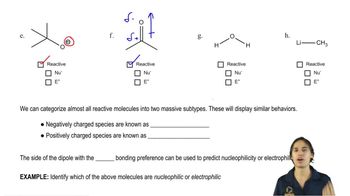
Reactivity of Molecules