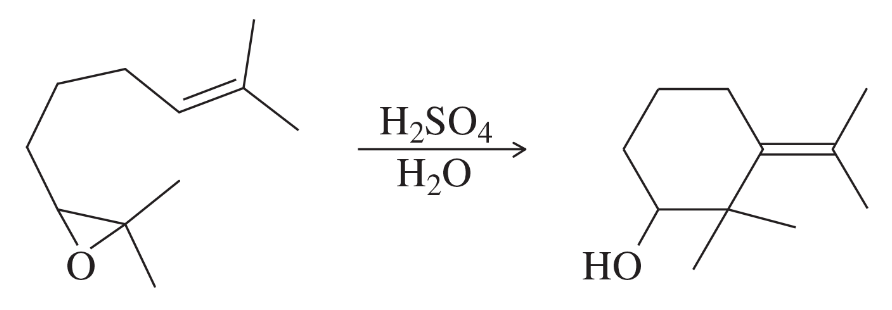
Step 1: Protonation of the epoxide ring. The reaction begins with the acid catalyst (H2SO4) protonating the oxygen atom of the epoxide ring, making it more electrophilic and susceptible to nucleophilic attack.
Step 2: Ring opening of the epoxide. Water (H2O) acts as a nucleophile and attacks the more substituted carbon of the epoxide ring, leading to the opening of the ring and forming a carbocation intermediate.
Step 3: Carbocation rearrangement. The carbocation formed undergoes rearrangement to stabilize itself. This involves a hydride shift or alkyl shift to form a more stable tertiary carbocation.
Step 4: Deprotonation to form the alcohol. A water molecule removes a proton from the intermediate, resulting in the formation of the alcohol group at the site of the carbocation.
Step 5: Formation of the final product. The double bond is retained in the structure, and the final product is formed with the hydroxyl group and the alkene in the correct positions as shown in the product structure.
Verified video answer for a similar problem:
This video solution was recommended by our tutors as helpful for the problem above
Video duration:
5m
Play a video:
0 Comments
Key Concepts
Here are the essential concepts you must grasp in order to answer the question correctly.
Acid-Catalyzed Hydration
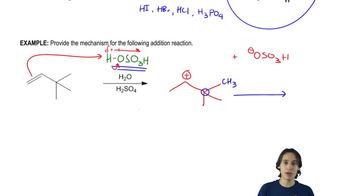
Acid-catalyzed hydration is a reaction where water adds to an alkene in the presence of an acid, typically sulfuric acid (H2SO4). The acid protonates the alkene, forming a more stable carbocation intermediate, which then reacts with water to form an alcohol. This mechanism is crucial for understanding how alkenes can be converted into alcohols through hydration.
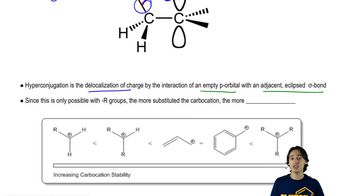
Carbocation stability is a key concept in organic chemistry that refers to the relative stability of positively charged carbon species. Carbocations are stabilized by alkyl groups through hyperconjugation and inductive effects. Understanding the stability of different carbocations helps predict the major products of reactions involving carbocation intermediates, such as in the hydration of alkenes.
Markovnikov's Rule states that in the addition of HX to an alkene, the hydrogen atom will attach to the carbon with the greater number of hydrogen atoms already attached, while the halide (or hydroxyl group in hydration) will attach to the carbon with fewer hydrogen atoms. This rule helps predict the regioselectivity of reactions involving alkenes, guiding the formation of the more stable product.