What is the index of hydrogen deficiency for each of the following molecular formulas? (a) C6H12O6
Verified step by step guidance
1
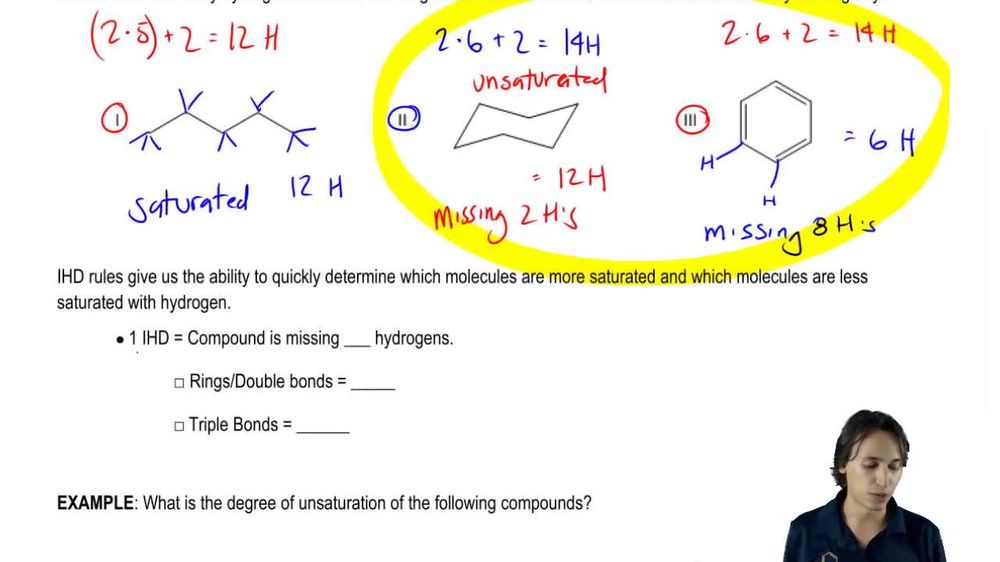
Step 1: Understand the concept of Index of Hydrogen Deficiency (IHD). IHD is a measure of the number of degrees of unsaturation in a molecule, which includes double bonds, triple bonds, and rings. It is calculated using the formula: IHD = (2C + 2 - H + N - X)/2, where C is the number of carbons, H is the number of hydrogens, N is the number of nitrogens, and X is the number of halogens.
Step 2: Identify the molecular formula provided in the problem. For part (a), the molecular formula is C₆H₁₂O₆. Note that oxygen atoms (O) do not affect the IHD calculation directly, as they do not contribute to the degree of unsaturation.
Step 3: Plug the values from the molecular formula into the IHD formula. Here, C = 6, H = 12, and there are no nitrogen (N) or halogen (X) atoms. The formula simplifies to: IHD = (2(6) + 2 - 12)/2.
Step 4: Perform the arithmetic inside the formula step by step. First, calculate the term 2C + 2, which is 2(6) + 2 = 14. Then subtract the number of hydrogens (H), which is 14 - 12 = 2. Finally, divide the result by 2 to determine the IHD.
Step 5: Interpret the result. The IHD value represents the number of degrees of unsaturation in the molecule, which could correspond to double bonds, triple bonds, or rings. This provides insight into the structure of the compound.
Verified video answer for a similar problem:
This video solution was recommended by our tutors as helpful for the problem above
Video duration:
3m
Play a video:
0 Comments
Key Concepts
Here are the essential concepts you must grasp in order to answer the question correctly.
Index of Hydrogen Deficiency (IHD)
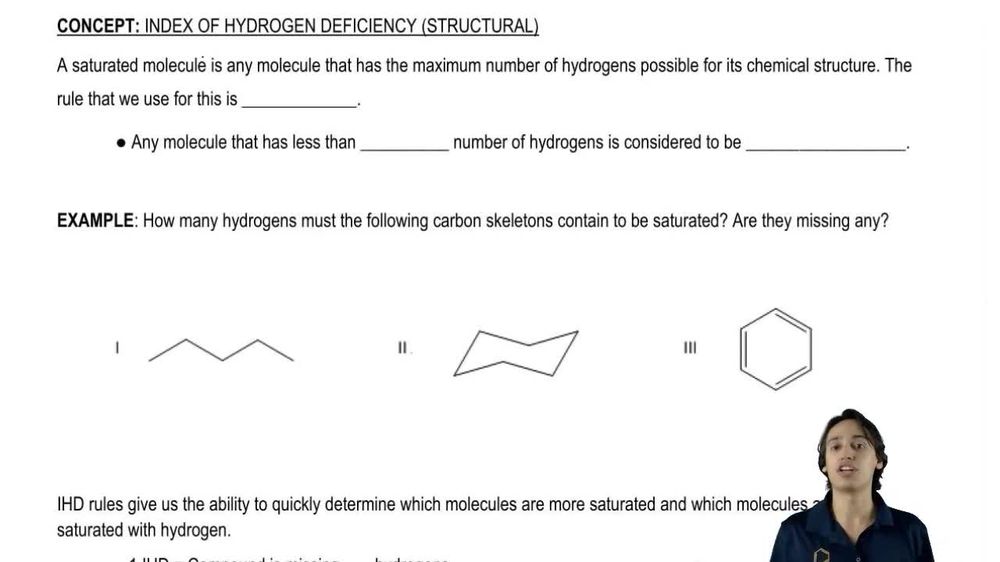
The Index of Hydrogen Deficiency (IHD) is a calculation used to determine the degree of unsaturation in a molecular formula. It indicates the number of rings and/or multiple bonds present in a compound. Each double bond or ring contributes one to the IHD, while each triple bond contributes two. The formula for calculating IHD is IHD = (2C + 2 + N - H - X) / 2, where C is the number of carbons, N is the number of nitrogens, H is the number of hydrogens, and X is the number of halogens.
A molecular formula provides the number of each type of atom in a molecule but does not convey structural information. For example, C₆H₁₂O₆ indicates a compound with six carbon atoms, twelve hydrogen atoms, and six oxygen atoms. Understanding how to interpret this formula is crucial for calculating the IHD, as it allows for the identification of the elements involved and their contributions to the overall structure and saturation of the molecule.
The degree of unsaturation refers to the presence of double bonds, triple bonds, or rings in a molecule, which affects its reactivity and stability. A higher degree of unsaturation typically indicates more reactive sites within the molecule. In the context of IHD, each unit of unsaturation corresponds to a specific structural feature, such as a double bond or a ring, which is essential for predicting the behavior of organic compounds in chemical reactions.

 3:04 minutes
 Verified step by step guidance
 01:15
01:15