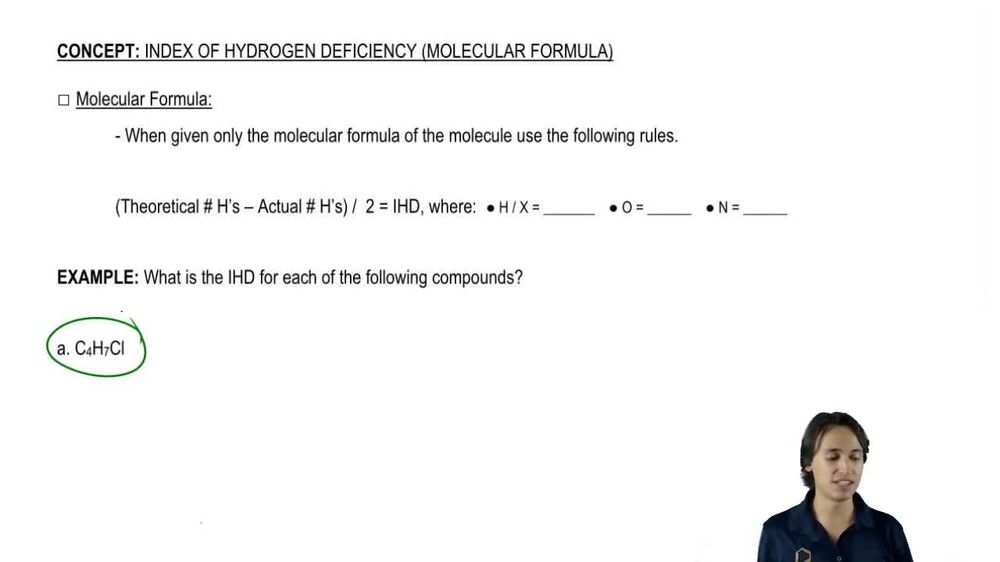
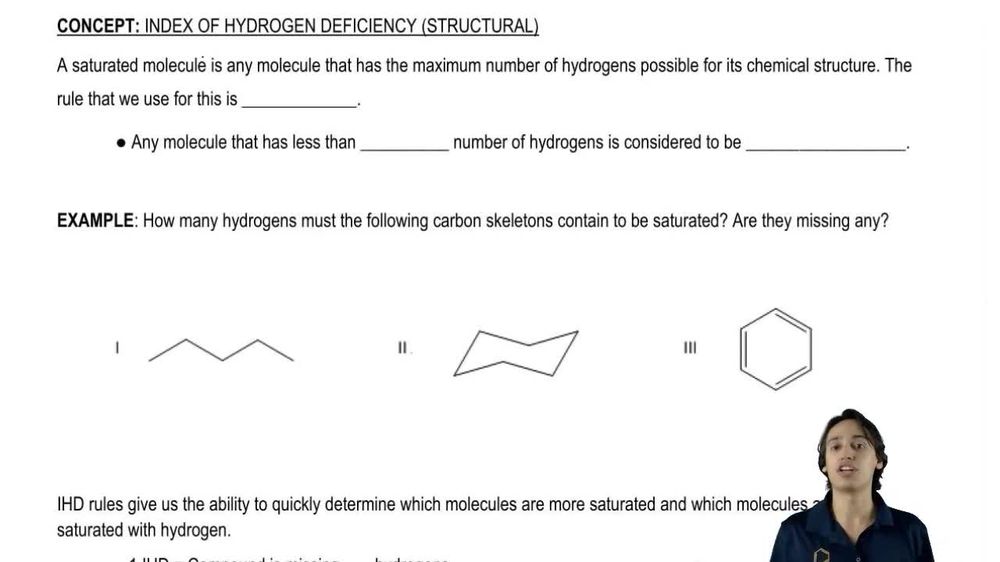
Calculate the index of hydrogen deficiency for the following molecular formulas and structures. (a)
Verified step by step guidance
1
Step 1: Understand the concept of the Index of Hydrogen Deficiency (IHD). The IHD is a measure of the degree of unsaturation in a molecule, indicating the number of rings, double bonds, or triple bonds present. It is calculated using the formula: IHD = (2C + 2 - H + N - X)/2, where C = number of carbons, H = number of hydrogens, N = number of nitrogens, and X = number of halogens.
Step 2: Identify the molecular formula provided in the problem. Extract the number of carbons (C), hydrogens (H), nitrogens (N), and halogens (X) from the formula.
Step 3: Substitute the values of C, H, N, and X into the IHD formula. Ensure that you follow the order of operations correctly: first calculate the numerator (2C + 2 - H + N - X), then divide by 2.
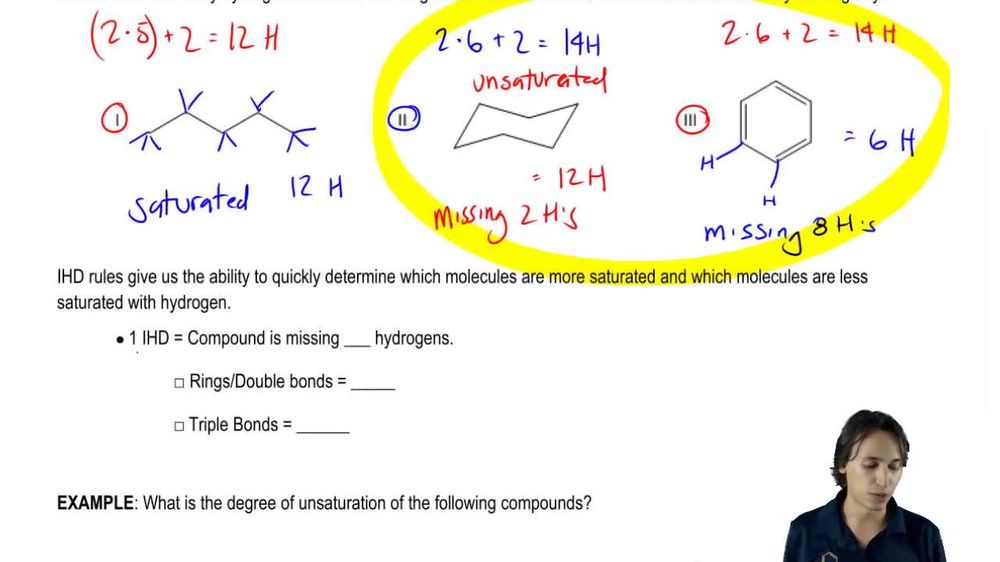
Step 4: Interpret the result of the IHD calculation. Each unit of IHD corresponds to one degree of unsaturation, which could be a ring, a double bond, or a triple bond. For example, an IHD of 1 could mean one double bond or one ring, while an IHD of 2 could mean two double bonds, one triple bond, or a combination of a ring and a double bond.
Step 5: If the problem includes a structure, verify the calculated IHD by analyzing the structure visually. Count the number of rings, double bonds, and triple bonds to confirm that the calculated IHD matches the structural features of the molecule.
Verified video answer for a similar problem:
This video solution was recommended by our tutors as helpful for the problem above
Video duration:
3m
Play a video:
0 Comments
Key Concepts
Here are the essential concepts you must grasp in order to answer the question correctly.
Index of Hydrogen Deficiency (IHD)
The Index of Hydrogen Deficiency (IHD) is a measure used in organic chemistry to determine the degree of unsaturation in a molecule. It indicates the number of rings and/or multiple bonds present in a compound. The formula for calculating IHD is IHD = (2C + 2 + N - H - X) / 2, where C is the number of carbons, N is the number of nitrogens, H is the number of hydrogens, and X is the number of halogens.
A molecular formula represents the number and types of atoms in a molecule, providing essential information about its composition. It is expressed as CxHy, where x and y denote the number of carbon and hydrogen atoms, respectively. Understanding the molecular formula is crucial for calculating the IHD, as it directly influences the values of C, H, N, and X in the IHD formula.
Unsaturation refers to the presence of double or triple bonds between carbon atoms or the presence of rings in a molecule. Each degree of unsaturation corresponds to a loss of hydrogen atoms compared to a saturated hydrocarbon. Recognizing unsaturation is vital for interpreting the IHD, as it helps predict the reactivity and stability of organic compounds.

 3:16 minutes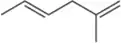
 Verified step by step guidance
 01:15
01:15