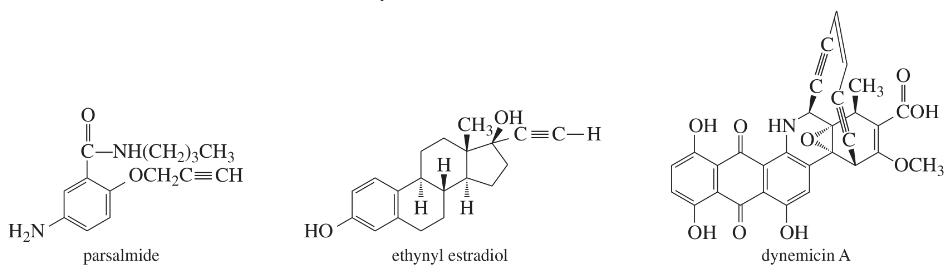
Count the elements of unsaturation in parsalmide, ethynyl estradiol, and dynemicin A.
Verified step by step guidance
1
Identify the formula for calculating elements of unsaturation: U = C - (H/2) - (X/2) + (N/2) + 1, where C is the number of carbons, H is the number of hydrogens, X is the number of halogens, and N is the number of nitrogens.
For parsalmide, count the number of carbon (C), hydrogen (H), nitrogen (N), and oxygen (O) atoms. Note that oxygen does not affect the unsaturation count.
Apply the formula to parsalmide using the counted atoms to determine the elements of unsaturation.
For ethynyl estradiol, repeat the process: count the number of C, H, N, and O atoms, and apply the formula to find the elements of unsaturation.
For dynemicin A, count the number of C, H, N, and O atoms, and apply the formula to determine the elements of unsaturation. Consider the presence of multiple rings and triple bonds in the structure.
Verified video answer for a similar problem:
This video solution was recommended by our tutors as helpful for the problem above
Video duration:
2m
Play a video:
0 Comments
Key Concepts
Here are the essential concepts you must grasp in order to answer the question correctly.
Elements of Unsaturation
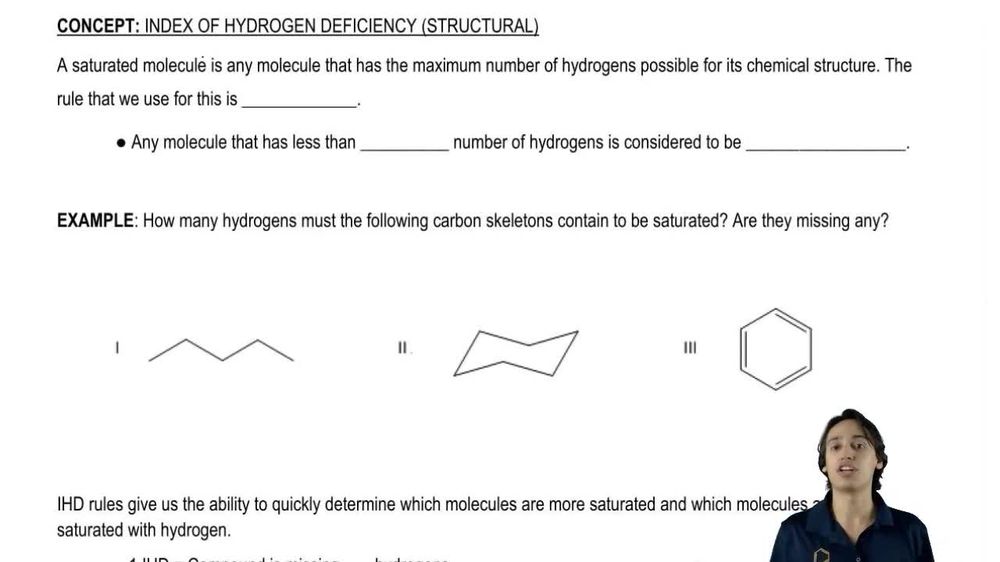
Elements of unsaturation, also known as degrees of unsaturation, refer to the total number of rings and multiple bonds (double and triple bonds) in a molecule. Each ring or double bond contributes one degree of unsaturation, while each triple bond contributes two. This concept helps determine the structural features of a molecule, such as the presence of rings or pi bonds.
The difference between saturated and unsaturated molecules.
Counting Unsaturation in Organic Molecules
To count the elements of unsaturation in a molecule, identify all rings, double bonds, and triple bonds. Each ring and double bond adds one to the count, while each triple bond adds two. For example, in ethynyl estradiol, the presence of one triple bond and several rings contributes to its unsaturation count, which is crucial for understanding its chemical properties.
The difference between saturated and unsaturated molecules.
Structural Analysis of Organic Compounds
Analyzing the structure of organic compounds involves identifying functional groups, rings, and multiple bonds. This analysis is essential for understanding the chemical behavior and reactivity of the compound. For instance, dynemicin A's complex structure with multiple rings and bonds requires careful examination to accurately determine its unsaturation and potential reactivity.