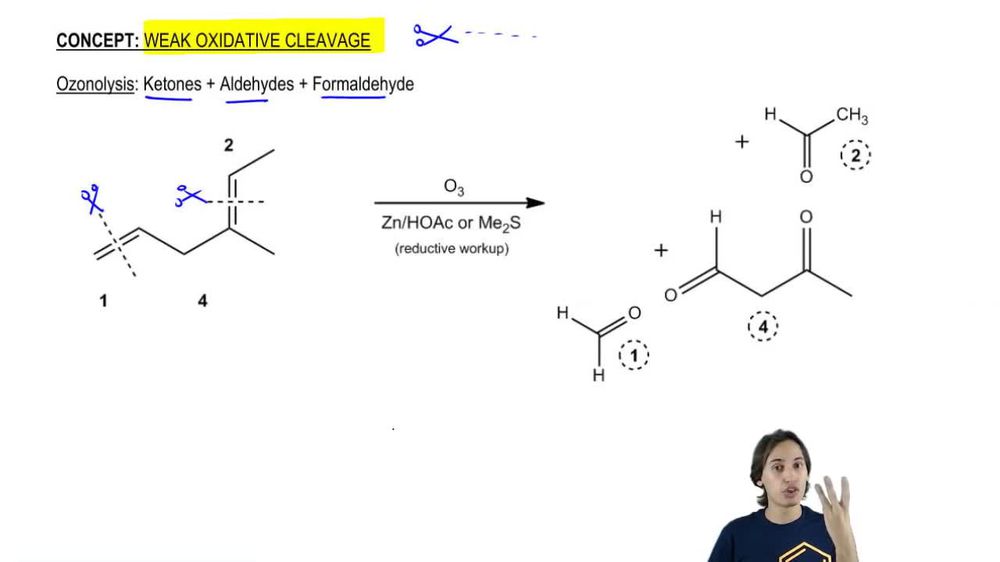
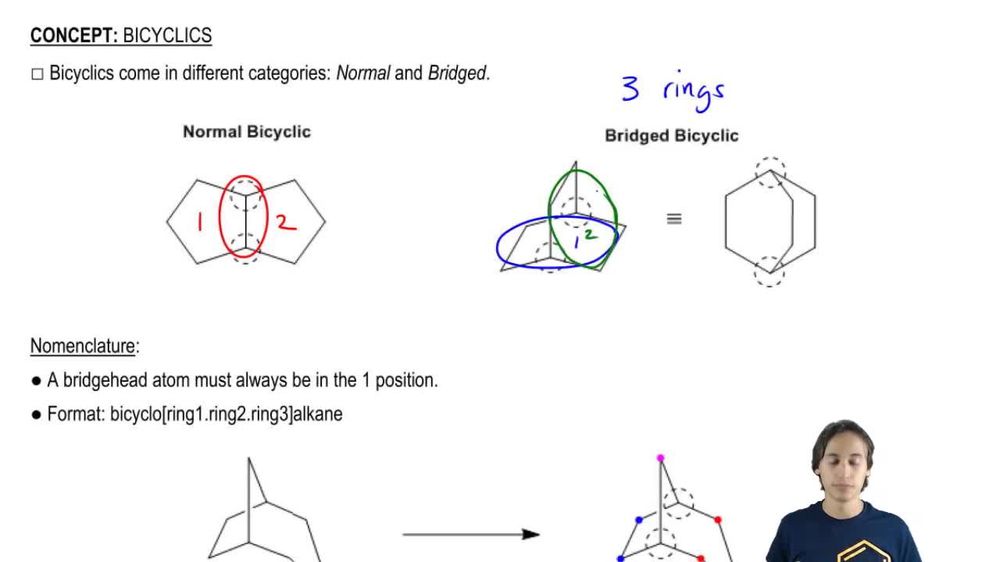
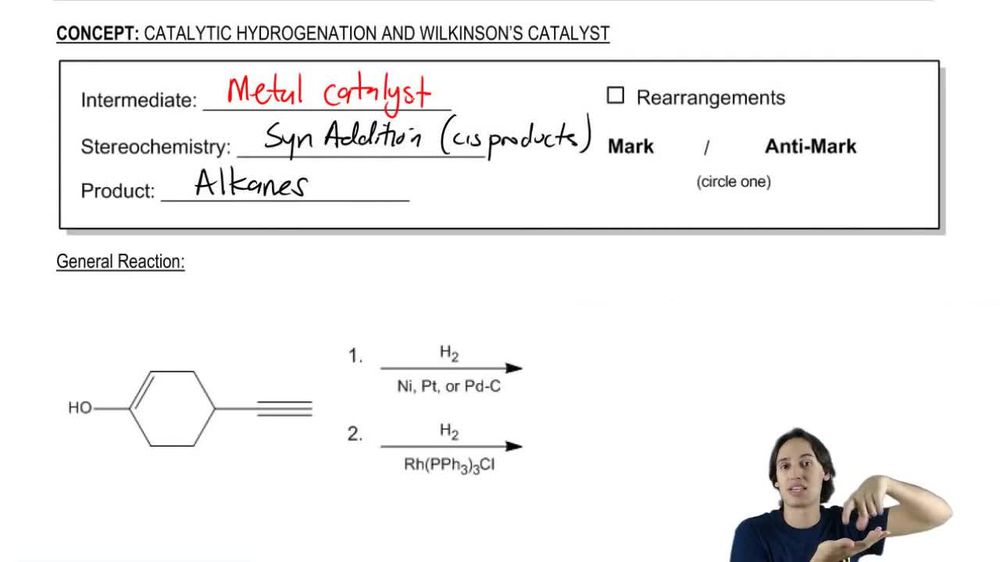
Deduce the structure of each compound from the information given. All unknowns in this problem have molecular formula C8H12. (c) Upon catalytic hydrogenation, unknown Y gives cyclooctane. Ozonolysis of Y, followed by reduction with dimethyl sulfide, gives a three-carbon dialdehyde and a five-carbon dialdehyde. Draw the structure of Y. (d) Upon catalytic hydrogenation, unknown Z gives cis-bicyclo[4.2.0]octane. Ozonolysis of Z, followed by reduction with dimethyl sulfide, gives a cyclobutane with a three-carbon aldehyde (–CH2–CH2–CHO) group on C1 and a one-carbon aldehyde (–CHO) group on C2. Draw the structure of Z.
Verified step by step guidance
1
Step 1: Analyze the molecular formula C8H12 for both unknowns Y and Z. This formula suggests that the compounds are unsaturated hydrocarbons with multiple degrees of unsaturation (double bonds, rings, or both). Calculate the degrees of unsaturation using the formula: Degrees of Unsaturation = (2C + 2 - H)/2. For C8H12, Degrees of Unsaturation = (2(8) + 2 - 12)/2 = 3.
Step 2: For unknown Y, note that catalytic hydrogenation yields cyclooctane, which is a saturated cyclic compound. This indicates that Y is a cyclic compound with three degrees of unsaturation, likely containing double bonds. Ozonolysis followed by reduction produces a three-carbon dialdehyde and a five-carbon dialdehyde, suggesting that Y contains two double bonds in specific positions that cleave to form these aldehydes. Deduce the positions of the double bonds based on the aldehyde fragments.
Step 3: For unknown Z, note that catalytic hydrogenation yields cis-bicyclo[4.2.0]octane, which is a bicyclic compound. This indicates that Z is a bicyclic compound with double bonds contributing to its three degrees of unsaturation. Ozonolysis followed by reduction produces a cyclobutane with aldehyde groups (-CH2-CH2-CHO and -CHO) attached to specific carbons. Deduce the positions of the double bonds in Z based on the aldehyde fragments and the structure of the cyclobutane.
Step 4: Use the information from ozonolysis and reduction to deduce the structures of Y and Z. For Y, the three-carbon dialdehyde and five-carbon dialdehyde suggest that the double bonds are positioned such that cleavage results in these fragments. For Z, the aldehyde groups on the cyclobutane suggest specific positions for the double bonds in the bicyclic structure.
Step 5: Draw the structures of Y and Z based on the deductions. For Y, ensure the structure satisfies the molecular formula C8H12, has three degrees of unsaturation, and produces the specified aldehyde fragments upon ozonolysis. For Z, ensure the structure satisfies the molecular formula C8H12, has three degrees of unsaturation, and produces the specified cyclobutane with aldehyde groups upon ozonolysis.
Verified video answer for a similar problem:
This video solution was recommended by our tutors as helpful for the problem above
Video duration:
6m
Play a video:
0 Comments
Key Concepts
Here are the essential concepts you must grasp in order to answer the question correctly.
Catalytic Hydrogenation
Catalytic hydrogenation is a chemical reaction that involves the addition of hydrogen (H2) to unsaturated organic compounds, typically in the presence of a catalyst such as palladium, platinum, or nickel. This process converts alkenes or alkynes into alkanes, effectively saturating the molecule. Understanding this concept is crucial for deducing the structure of compounds Y and Z, as it provides insight into how these compounds can be transformed into simpler saturated forms.
Ozonolysis is a reaction involving the cleavage of alkenes or alkynes using ozone (O3), resulting in the formation of carbonyl compounds, such as aldehydes or ketones. This reaction is significant in organic synthesis for determining the structure of complex molecules, as it breaks down larger structures into identifiable fragments. In the context of the question, ozonolysis helps to identify the components of compounds Y and Z after their hydrogenation.
Bicyclic compounds are organic molecules that contain two interconnected rings. Their unique structure can influence their reactivity and stability, making them important in organic chemistry. In the case of compound Z, the formation of cis-bicyclo[4.2.0]octane upon hydrogenation indicates specific stereochemical and structural features that must be considered when deducing its original structure. Understanding bicyclic systems is essential for accurately interpreting the results of the reactions described.