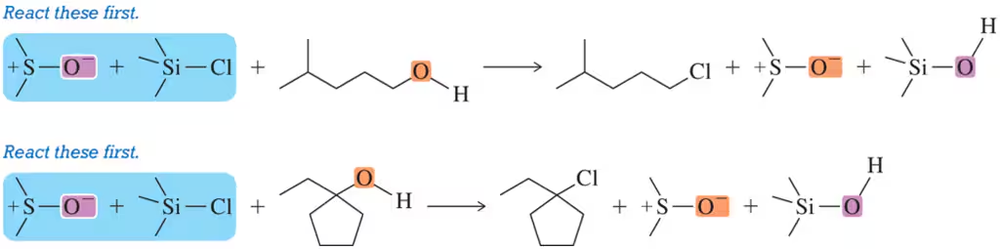
Another method for converting alcohols to chloroalkanes makes use of chlorotrimethylsilane (TMSCl) and DMSO. Suggest a mechanism for this reaction to form (a) a 1° chloroalkane and (b) a 3° chloroalkane. [The reaction begins by the reaction of DMSO and TMSCl and is analogous to the Swern oxidation.]
Verified step by step guidance
1
Begin by understanding the role of chlorotrimethylsilane (TMSCl) and dimethyl sulfoxide (DMSO) in the reaction. TMSCl is used to activate DMSO, forming an intermediate that facilitates the conversion of alcohols to chloroalkanes.
The first step involves the reaction between DMSO and TMSCl. DMSO acts as a nucleophile, attacking the silicon atom in TMSCl, leading to the formation of a sulfoxonium ion. This step is crucial as it sets up the intermediate needed for the subsequent steps.
For the conversion of a primary alcohol to a 1° chloroalkane, the alcohol oxygen attacks the activated DMSO, forming a complex. This complex facilitates the departure of the hydroxyl group as a leaving group, allowing the chloride ion to replace it, forming the chloroalkane.
In the case of a tertiary alcohol, the mechanism is similar but involves a more stable carbocation intermediate due to the tertiary nature of the alcohol. The tertiary alcohol forms a complex with the activated DMSO, leading to the formation of a carbocation, which is then attacked by the chloride ion to form the 3° chloroalkane.
Throughout the mechanism, the role of DMSO is analogous to its role in the Swern oxidation, where it acts as an oxidizing agent. However, in this reaction, it facilitates the conversion of alcohols to chloroalkanes by forming a reactive intermediate with TMSCl.
Verified video answer for a similar problem:
This video solution was recommended by our tutors as helpful for the problem above
Play a video:
0 Comments
Key Concepts
Here are the essential concepts you must grasp in order to answer the question correctly.
Swern Oxidation
Swern oxidation is a method used to convert alcohols into carbonyl compounds using chlorotrimethylsilane (TMSCl) and dimethyl sulfoxide (DMSO). The process involves the formation of an alkoxysilane intermediate, which is then oxidized to yield the desired carbonyl product. Understanding this mechanism is crucial for applying similar principles to convert alcohols into chloroalkanes.
Nucleophilic substitution is a fundamental reaction in organic chemistry where a nucleophile replaces a leaving group in a molecule. In the context of converting alcohols to chloroalkanes, the mechanism typically involves the formation of a good leaving group (like chloride) from the alcohol, followed by the attack of a nucleophile. This concept is essential for predicting the products of the reaction and understanding the reactivity of different alcohols.
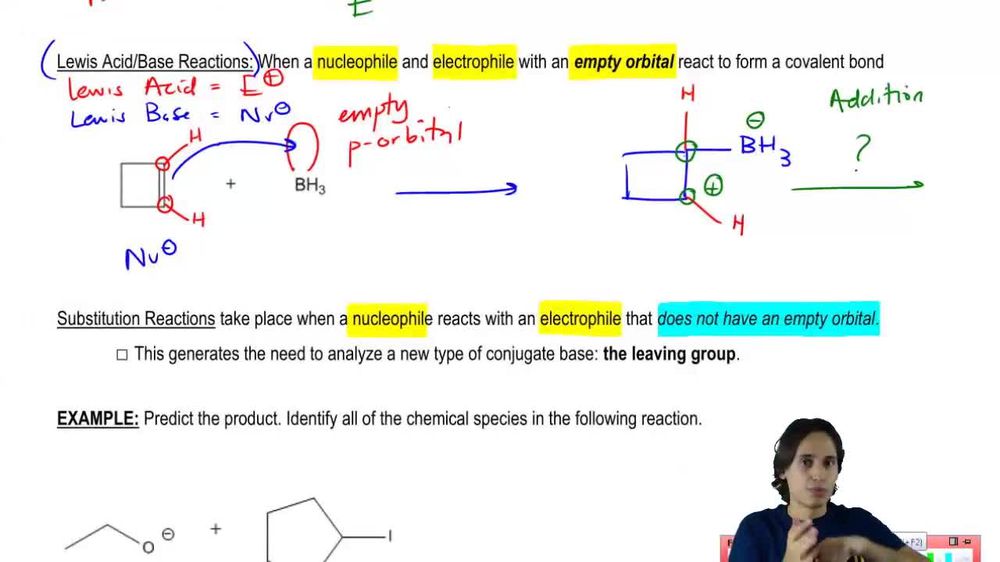
Nucleophiles and Electrophiles can react in Substitution Reactions.
Primary vs. Tertiary Chloroalkanes
The distinction between primary (1°) and tertiary (3°) chloroalkanes is based on the number of carbon atoms bonded to the carbon atom that carries the chlorine atom. Primary chloroalkanes have one carbon attached, while tertiary chloroalkanes have three. This classification affects the reaction mechanism, as 1° substrates typically undergo bimolecular nucleophilic substitution (SN2), while 3° substrates often proceed via unimolecular nucleophilic substitution (SN1), influencing the overall reaction pathway.

 Verified step by step guidance
 03:40
03:40