Predict the product(s) that would result when the alkenes are allowed to react under the following conditions: (v) mCPBA; (h)
Verified step by step guidance
1
Identify the functional group in the starting material: The problem involves alkenes, which are compounds containing a carbon-carbon double bond (C=C). Alkenes are reactive toward electrophilic additions and oxidation reactions.
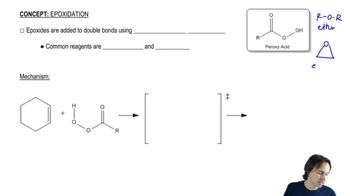
Understand the reagent: mCPBA (meta-chloroperoxybenzoic acid) is a peracid commonly used for epoxidation of alkenes. It reacts with the double bond to form an epoxide (a three-membered cyclic ether).
Determine the reaction mechanism: The reaction proceeds via a concerted mechanism where the oxygen from mCPBA is transferred to the double bond, forming the epoxide. This process is stereospecific, meaning the stereochemistry of the starting alkene (cis or trans) is retained in the product.
Predict the product: Draw the structure of the epoxide by replacing the double bond in the alkene with a three-membered oxygen-containing ring. Ensure that the stereochemistry of the substituents on the alkene is preserved in the epoxide.
Verify the stereochemistry: If the alkene is cis, the substituents on the epoxide will be on the same side (cis). If the alkene is trans, the substituents on the epoxide will be on opposite sides (trans). This step ensures the product is consistent with the stereospecific nature of the reaction.
Verified video answer for a similar problem:
This video solution was recommended by our tutors as helpful for the problem above
Play a video:
0 Comments
Key Concepts
Here are the essential concepts you must grasp in order to answer the question correctly.
Alkenes
Alkenes are hydrocarbons that contain at least one carbon-carbon double bond (C=C). They are unsaturated compounds, meaning they have fewer hydrogen atoms than alkanes with the same number of carbon atoms. The presence of the double bond makes alkenes more reactive than alkanes, allowing them to undergo various chemical reactions, including addition and oxidation.
mCPBA is a peracid commonly used in organic chemistry for the epoxidation of alkenes. It introduces an oxygen atom across the double bond, forming an epoxide, which is a three-membered cyclic ether. This reaction is stereospecific and can lead to the formation of different stereoisomers depending on the configuration of the starting alkene.
Epoxidation is a chemical reaction that converts alkenes into epoxides through the addition of an oxygen atom. This reaction typically occurs under mild conditions and is important in organic synthesis because epoxides are highly reactive intermediates that can be further transformed into a variety of functional groups. The reaction is significant for creating complex molecules in pharmaceuticals and natural products.


 Verified step by step guidance
 2:09
2:09