Consider the following reaction: HBr + -C≡N ⇌ Br− + HC≡N g. What is the conjugate base of the acid on the right? h. What is the conjugate acid of the base on the right?
Verified step by step guidance
1
Step 1: Understand the concept of conjugate acid-base pairs. A conjugate base is formed when an acid donates a proton (H⁺), and a conjugate acid is formed when a base accepts a proton.
Step 2: Analyze the reaction provided. On the right side of the equilibrium, the acid is HC≡N (hydrogen cyanide). To find its conjugate base, remove a proton (H⁺) from HC≡N.
Step 3: Write the chemical formula for the conjugate base of HC≡N. Removing a proton from HC≡N results in C≡N⁻ (cyanide ion). This is the conjugate base of the acid HC≡N.
Step 4: On the right side of the equilibrium, the base is Br⁻ (bromide ion). To find its conjugate acid, add a proton (H⁺) to Br⁻.
Step 5: Write the chemical formula for the conjugate acid of Br⁻. Adding a proton to Br⁻ results in HBr (hydrogen bromide). This is the conjugate acid of the base Br⁻.
Verified video answer for a similar problem:
This video solution was recommended by our tutors as helpful for the problem above
Video duration:
4m
Play a video:
0 Comments
Key Concepts
Here are the essential concepts you must grasp in order to answer the question correctly.
Conjugate Acid-Base Pairs
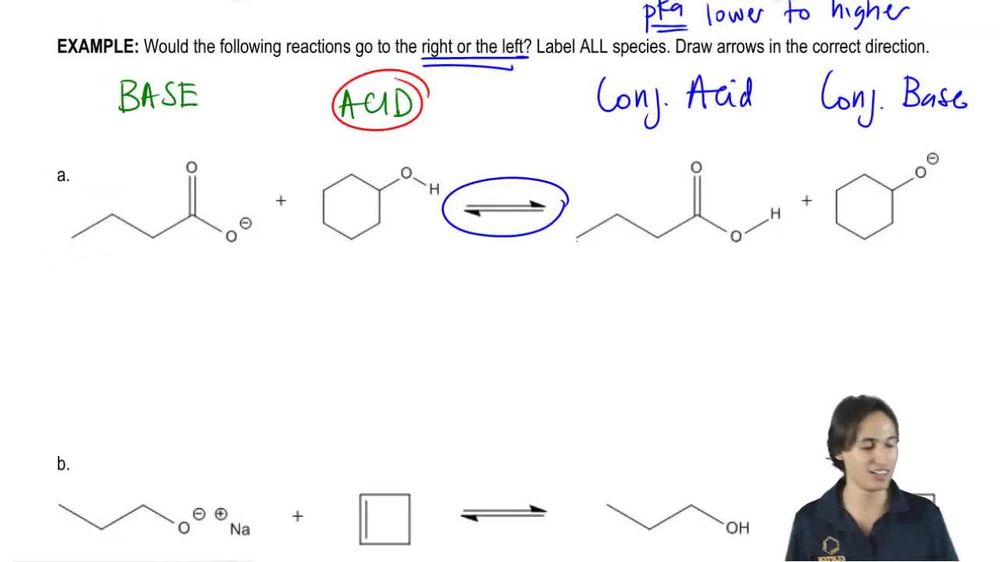
In acid-base chemistry, a conjugate acid is formed when a base gains a proton (H+), while a conjugate base is what remains after an acid donates a proton. Understanding these pairs is crucial for identifying the relationships between acids and bases in a reaction.
Acidity refers to the tendency of a substance to donate protons, while basicity refers to the ability to accept protons. The strength of an acid or base can influence the direction of a reaction and the stability of the resulting conjugate pairs.
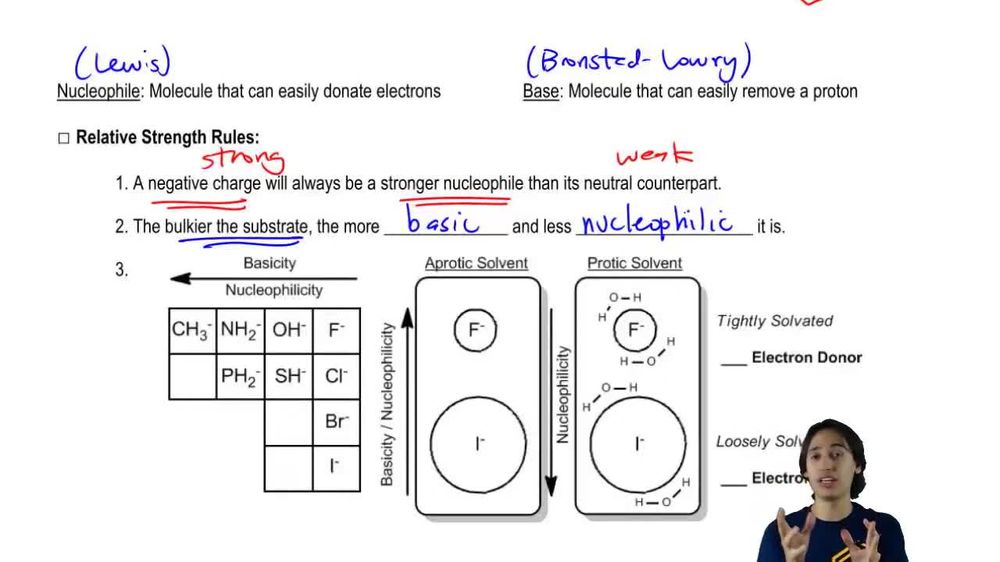
Understanding the difference between basicity and nucleophilicity.
Equilibrium in Acid-Base Reactions
Acid-base reactions often reach a state of equilibrium, where the forward and reverse reactions occur at the same rate. This concept is essential for understanding how to identify conjugate acids and bases in a given reaction, as it helps predict the predominant species present at equilibrium.

 4:17 minutes
 Verified step by step guidance
 2:56
2:56