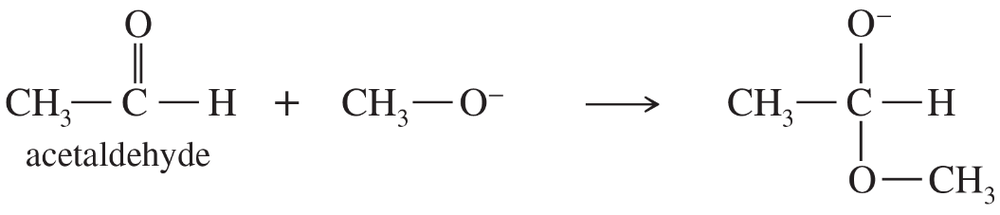
In the following acid–base reactions, 1. draw Lewis structures of the reactants and the products. 2. determine which species are acting as electrophiles (acids) and which are acting as nucleophiles (bases). 3. use the curved-arrow formalism to show the movement of electron pairs in these reactions, as well as the imaginary movement in the resonance hybrids of the products. 4. indicate which reactions are best termed Brønsted–Lowry acid–base reactions. (b)
Verified step by step guidance
1
Draw the Lewis structures for the reactants: Acetaldehyde (CH3CHO) has a carbonyl group (C=O) with a hydrogen and a methyl group (CH3) attached to the carbon. The methoxide ion (CH3O-) has a negatively charged oxygen with a lone pair of electrons.
Identify the electrophile and nucleophile: In this reaction, acetaldehyde acts as the electrophile (acid) because the carbonyl carbon is electron-deficient and can accept electrons. The methoxide ion acts as the nucleophile (base) because it donates a pair of electrons from its negatively charged oxygen.
Use curved-arrow formalism to show electron movement: Draw a curved arrow from the lone pair on the oxygen of the methoxide ion to the carbonyl carbon of acetaldehyde, indicating the formation of a new C-O bond. Another arrow should be drawn from the pi bond of the carbonyl group to the oxygen, showing the electrons moving to form a new lone pair on the oxygen.
Draw the Lewis structure of the product: The product is an alkoxide ion, [CH3C(O)H(OCH3)]-. The carbonyl carbon now has an additional OCH3 group attached, and the oxygen from the original carbonyl group carries a negative charge with three lone pairs.
Determine if the reaction is a Brønsted–Lowry acid–base reaction: This reaction is not a typical Brønsted–Lowry acid–base reaction because it involves the transfer of an electron pair rather than a proton. It is better described as a nucleophilic addition reaction.
Verified video answer for a similar problem:

This video solution was recommended by our tutors as helpful for the problem above
Video duration:
8m
Play a video:
0 Comments
Key Concepts
Here are the essential concepts you must grasp in order to answer the question correctly.
Lewis Structures
Lewis structures are diagrams that represent the bonding between atoms in a molecule and the lone pairs of electrons that may exist. They help visualize the arrangement of electrons and the connectivity of atoms, which is crucial for understanding chemical reactions. In the context of acid-base reactions, drawing Lewis structures allows one to identify the electron-rich and electron-deficient sites, aiding in the determination of nucleophiles and electrophiles.
Electrophiles are species that accept electron pairs, typically acting as acids in chemical reactions, while nucleophiles are electron-rich species that donate electron pairs, acting as bases. Understanding the roles of these species is essential for analyzing acid-base reactions, as it helps predict the direction of electron flow and the formation of products. In the provided reaction, the acetaldehyde acts as an electrophile, while the alkoxide ion (CH3O-) serves as a nucleophile.
The Brønsted–Lowry theory defines acids as proton donors and bases as proton acceptors. This framework is particularly useful for understanding acid-base reactions in organic chemistry, as it emphasizes the transfer of protons between species. In the given reaction, identifying which species donates and accepts protons will clarify the acid-base nature of the reaction, allowing for a deeper understanding of the underlying mechanisms.