Ethylene oxide reacts readily with HO- because of the strain in the three-membered ring. Explain why cyclopropane, a compound with approximately the same amount of strain, does not react with HO-.
Verified step by step guidance
1
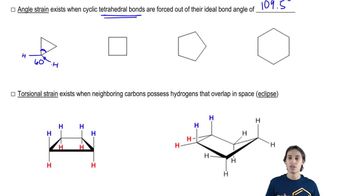
Understand the structure and reactivity of ethylene oxide: Ethylene oxide is a three-membered cyclic ether (epoxide) with significant ring strain due to its bond angles being much smaller than the ideal tetrahedral angle of 109.5°. This strain makes the molecule highly reactive, especially toward nucleophiles like HO⁻.
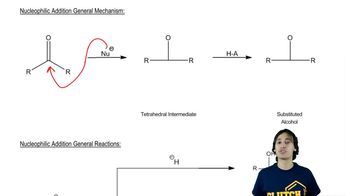
Analyze the reaction mechanism of ethylene oxide with HO⁻: The nucleophile (HO⁻) attacks the electrophilic carbon in the epoxide ring, leading to ring opening. This reaction is facilitated by the partial positive charge on the carbon atoms of the epoxide due to the electronegativity of oxygen.
Compare the structure of cyclopropane: Cyclopropane is a three-membered ring hydrocarbon with similar ring strain due to its compressed bond angles. However, unlike ethylene oxide, cyclopropane lacks an electronegative atom like oxygen, which would create an electrophilic site for nucleophilic attack.
Explain the lack of reactivity of cyclopropane with HO⁻: Cyclopropane is composed of only carbon and hydrogen atoms, which are nonpolar and do not provide an electrophilic site for the nucleophile (HO⁻) to attack. The absence of a polar bond or partial charges in cyclopropane makes it inert to nucleophilic attack under normal conditions.
Conclude the reasoning: The key difference lies in the presence of an electrophilic site in ethylene oxide due to the oxygen atom, which facilitates nucleophilic attack and ring opening. Cyclopropane, despite having similar ring strain, does not have such a site, and therefore does not react with HO⁻.
Verified video answer for a similar problem:
This video solution was recommended by our tutors as helpful for the problem above
Video duration:
2m
Play a video:
0 Comments
Key Concepts
Here are the essential concepts you must grasp in order to answer the question correctly.
Ring Strain
Ring strain occurs in cyclic compounds when the bond angles deviate from the ideal tetrahedral angle of 109.5 degrees, leading to increased energy and reactivity. In ethylene oxide, the three-membered ring creates significant angle strain, making it more reactive towards nucleophiles like HO-. Cyclopropane also has ring strain, but its stability is enhanced by the ability to adopt a more favorable conformation.
Nucleophilic attack involves a nucleophile, such as HO-, attacking an electrophilic center in a molecule. Ethylene oxide's strained ring makes the carbon atoms more electrophilic, facilitating this reaction. In contrast, cyclopropane lacks such electrophilic centers due to its stable structure, making it less susceptible to nucleophilic attack despite having similar strain.
Cyclopropane is relatively stable due to its ability to maintain a planar structure, which minimizes torsional strain. This stability results in lower reactivity compared to ethylene oxide, where the strain leads to a higher energy state. Consequently, cyclopropane does not readily undergo reactions with nucleophiles like HO-, as it does not have the same driving force for reaction as ethylene oxide.