Ch. 1 - Remembering General Chemistry: Electronic Structure and Bonding (Part 2)
Bruice - Organic Chemistry 8th Edition
Bruice8th EditionOrganic ChemistryISBN: 9780135213711Not the one you use?Change textbook
Chapter 2, Problem 72a

a. Which of the species have bond angles of 109.5°?
b. Which of the species have bond angles of 120°?
H2O H3O+ +CH3 BF3

Verified step by step guidance
1
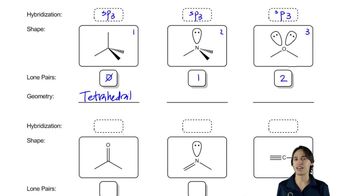
Step 1: Understand the bond angles associated with different molecular geometries. Bond angles of 109.5° are characteristic of tetrahedral geometry, while bond angles of 120° are characteristic of trigonal planar geometry.
Step 2: Analyze the molecular geometry of H2O. H2O has two bonding pairs and two lone pairs of electrons around the central oxygen atom. This results in a bent geometry with bond angles slightly less than 109.5° due to lone pair repulsion.
Step 3: Analyze the molecular geometry of H3O+. H3O+ has three bonding pairs and one lone pair of electrons around the central oxygen atom. This results in a trigonal pyramidal geometry with bond angles close to 109.5°.
Step 4: Analyze the molecular geometry of +CH3. The methyl cation (+CH3) has three bonding pairs and no lone pairs around the central carbon atom. This results in a trigonal planar geometry with bond angles of 120°.
Step 5: Analyze the molecular geometry of BF3. BF3 has three bonding pairs and no lone pairs around the central boron atom. This results in a trigonal planar geometry with bond angles of 120°.

Verified video answer for a similar problem:

This video solution was recommended by our tutors as helpful for the problem above.
Video duration:
3m
Was this helpful?

Key Concepts

Here are the essential concepts you must grasp in order to answer the question correctly.

Tetrahedral Geometry

Tetrahedral geometry occurs when a central atom is bonded to four other atoms, resulting in bond angles of approximately 109.5°. This arrangement minimizes electron pair repulsion according to VSEPR (Valence Shell Electron Pair Repulsion) theory, which predicts the spatial arrangement of atoms in a molecule.
Recommended video:
Guided course
07:44
Molecular Geometry Explained.

Trigonal Planar Geometry

Trigonal planar geometry is characterized by a central atom bonded to three other atoms, forming bond angles of 120°. This geometry arises from the arrangement of electron pairs around the central atom, which also follows VSEPR theory, allowing for optimal spacing between the electron pairs.
Recommended video:
Guided course
07:44
Molecular Geometry Explained.

VSEPR Theory

VSEPR (Valence Shell Electron Pair Repulsion) theory is a model used to predict the shape of molecules based on the repulsion between electron pairs surrounding a central atom. By considering both bonding and lone pairs, VSEPR helps determine the molecular geometry and associated bond angles, which are crucial for understanding molecular behavior and reactivity.
Recommended video:
Guided course
10:48
Equipment and Theory