Ch. 1 - Remembering General Chemistry: Electronic Structure and Bonding (Part 2)
Bruice - Organic Chemistry 8th Edition
Bruice8th EditionOrganic ChemistryISBN: 9780135213711Not the one you use?Change textbook
Chapter 2, Problem 77b,c

  1. CH3N2+
  2. HNO3
  3. N3-
  4. CH3CONH2
  5. O3
b. Draw a structure for each of the species that shows approximate bond angles.
c. Which species have no dipole moment?

Verified step by step guidance
1
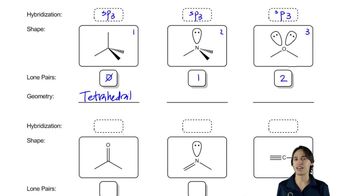
Step 1: Identify the species mentioned in the problem. For each species, determine its molecular geometry using VSEPR theory. This will help predict the approximate bond angles based on the arrangement of electron pairs around the central atom.
Step 2: Draw the Lewis structure for each species. Ensure you account for all valence electrons, including lone pairs and bonding pairs, to accurately represent the molecular structure.
Step 3: Based on the molecular geometry, assign approximate bond angles. For example, linear molecules typically have bond angles of 180°, trigonal planar molecules have bond angles of 120°, and tetrahedral molecules have bond angles of 109.5°. Adjust these values slightly if lone pairs are present, as they can compress bond angles.
Step 4: To determine which species have no dipole moment, evaluate the symmetry of the molecule. A molecule will have no dipole moment if it is symmetrical and the individual bond dipoles cancel out. For example, molecules like CO2 (linear) or CH4 (tetrahedral) are nonpolar due to their symmetry.
Step 5: Confirm your findings by considering electronegativity differences between atoms in the molecule. If the molecule is symmetrical and the electronegativity differences do not create a net dipole, the species will have no dipole moment.

Verified video answer for a similar problem:

This video solution was recommended by our tutors as helpful for the problem above.
Video duration:
4m
Was this helpful?

Key Concepts

Here are the essential concepts you must grasp in order to answer the question correctly.

Molecular Geometry

Molecular geometry refers to the three-dimensional arrangement of atoms within a molecule. It is determined by the number of bonding pairs and lone pairs of electrons around the central atom, which influences bond angles. Understanding molecular geometry is crucial for predicting the shape of a molecule and its physical properties, including polarity.
Recommended video:
Guided course
07:44
Molecular Geometry Explained.

Bond Angles

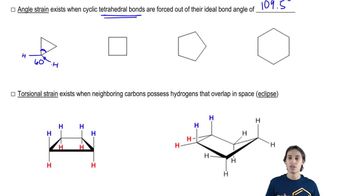
Bond angles are the angles formed between adjacent bonds in a molecule. They are influenced by the molecular geometry and the repulsion between electron pairs, which can alter the expected angles. For example, in a tetrahedral geometry, the bond angles are approximately 109.5 degrees, while in a trigonal planar geometry, they are about 120 degrees.
Recommended video:
Guided course
02:46
What is angle strain?

Dipole Moment

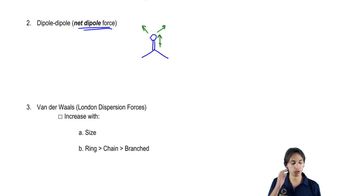
A dipole moment is a measure of the separation of positive and negative charges in a molecule, indicating its polarity. Molecules with an uneven distribution of electron density exhibit a dipole moment, while symmetrical molecules often do not. Identifying whether a species has a dipole moment is essential for understanding its interactions and solubility in different solvents.
Recommended video:
Guided course
01:46
How dipole-dipole forces work.