Ch. 1 - Remembering General Chemistry: Electronic Structure and Bonding (Part 2)
Bruice - Organic Chemistry 8th Edition
Bruice8th EditionOrganic ChemistryISBN: 9780135213711Not the one you use?Change textbook
Chapter 2, Problem 61c,d

Predict the approximate bond angles for the following:
c. the C—C—N bond angle in CH3C≡N
d. the C—C—N bond angle in CH3CH2NH2

Verified step by step guidance
1
Analyze the molecular geometry of CH3C≡N: The molecule contains a carbon-carbon triple bond (C≡N) and a methyl group (CH3). The carbon atom in the triple bond is sp-hybridized, resulting in a linear geometry around the C≡N bond. This means the C—C—N bond angle will be approximately 180°.
Understand the hybridization of the central atoms in CH3CH2NH2: The molecule contains a single-bonded carbon chain (CH3CH2) and an amine group (NH2). The carbon atoms in the chain are sp³-hybridized, and the nitrogen atom in the NH2 group is also sp³-hybridized. This results in a tetrahedral geometry around these atoms.
Consider the effect of lone pairs on the nitrogen atom in CH3CH2NH2: The nitrogen atom has one lone pair of electrons, which exerts greater repulsion than bonding pairs. This slightly reduces the bond angles around the nitrogen atom from the ideal tetrahedral angle of 109.5°.
Predict the approximate bond angle for the C—C—N bond in CH3CH2NH2: The C—C—N bond angle will be slightly less than 109.5° due to the lone pair on the nitrogen atom causing bond angle compression.
Summarize the bond angles: For CH3C≡N, the C—C—N bond angle is approximately 180° due to the linear geometry. For CH3CH2NH2, the C—C—N bond angle is slightly less than 109.5° due to the sp³ hybridization and lone pair repulsion on the nitrogen atom.

Verified video answer for a similar problem:

This video solution was recommended by our tutors as helpful for the problem above.
Video duration:
3m
Was this helpful?

Key Concepts

Here are the essential concepts you must grasp in order to answer the question correctly.

Hybridization

Hybridization is the concept of mixing atomic orbitals to form new hybrid orbitals that can accommodate bonding. In the case of carbon and nitrogen, sp, sp2, and sp3 hybridizations determine the geometry and bond angles. For example, sp hybridization leads to linear geometry with a bond angle of 180°, while sp3 results in tetrahedral geometry with bond angles around 109.5°.
Recommended video:
Guided course
10:43
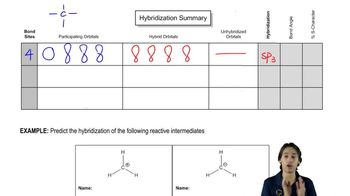
Using bond sites to predict hybridization

VSEPR Theory

Valence Shell Electron Pair Repulsion (VSEPR) Theory is used to predict the geometry of molecules based on the repulsion between electron pairs. According to VSEPR, electron pairs, whether bonding or lone pairs, will arrange themselves to minimize repulsion, thus determining the bond angles. This theory helps in predicting the angles in molecules like CH3C≡N and CH3CH2NH2.
Recommended video:
Guided course
10:48
Equipment and Theory

Bond Angles in Aliphatic Compounds

In aliphatic compounds, the bond angles are influenced by the types of bonds present (single, double, or triple) and the hybridization of the atoms involved. For instance, in CH3C≡N, the presence of a triple bond between carbon and nitrogen results in a linear arrangement with a bond angle of approximately 180°. In contrast, CH3CH2NH2 has a tetrahedral arrangement around the carbon atoms, leading to bond angles closer to 109.5°.
Recommended video:
Guided course
01:40
Defining meso compounds.