Ch. 1 - Remembering General Chemistry: Electronic Structure and Bonding (Part 2)
Bruice - Organic Chemistry 8th Edition
Bruice8th EditionOrganic ChemistryISBN: 9780135213711Not the one you use?Change textbook
Chapter 2, Problem 62a,b

Show the direction of the dipole moment in each of the following bonds (use the electronegativities given in [Table 1.3] ):
a. H3C—Br
b. H3C—Li

Verified step by step guidance
1
Step 1: Recall that the dipole moment in a bond is determined by the difference in electronegativity between the two atoms. The more electronegative atom will attract the shared electrons more strongly, creating a partial negative charge (δ⁻), while the less electronegative atom will have a partial positive charge (δ⁺).
Step 2: For the bond H₃C—Br: Look up the electronegativities of carbon (C) and bromine (Br) in Table 1.3. Bromine is more electronegative than carbon. Therefore, the dipole moment will point from the carbon atom (δ⁺) to the bromine atom (δ⁻).
Step 3: For the bond H₃C—Li: Look up the electronegativities of carbon (C) and lithium (Li) in Table 1.3. Carbon is more electronegative than lithium. Therefore, the dipole moment will point from the lithium atom (δ⁺) to the carbon atom (δ⁻).
Step 4: Represent the dipole moment direction using an arrow. For H₃C—Br, draw an arrow pointing toward Br (→) to indicate the dipole moment direction. For H₃C—Li, draw an arrow pointing toward C (→) to indicate the dipole moment direction.
Step 5: Summarize the results: In H₃C—Br, the dipole moment points toward Br due to its higher electronegativity. In H₃C—Li, the dipole moment points toward C due to its higher electronegativity.

Verified video answer for a similar problem:

This video solution was recommended by our tutors as helpful for the problem above.
Video duration:
2m
Was this helpful?

Key Concepts

Here are the essential concepts you must grasp in order to answer the question correctly.

Electronegativity

Electronegativity is a measure of an atom's ability to attract and hold onto electrons in a chemical bond. It is a key factor in determining the polarity of a bond; the greater the difference in electronegativity between two bonded atoms, the more polar the bond will be. For example, in a bond between carbon and bromine, bromine's higher electronegativity means it will attract the shared electrons more strongly, creating a dipole moment.
Recommended video:
Guided course
1:47
Electronegativity

Dipole Moment

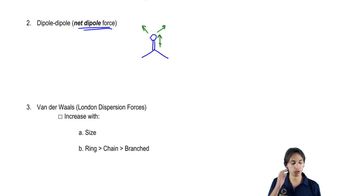
A dipole moment is a vector quantity that represents the separation of positive and negative charges in a molecule. It is directed from the positive pole (less electronegative atom) to the negative pole (more electronegative atom). The dipole moment is crucial for understanding molecular polarity and reactivity, as it influences intermolecular forces and the behavior of molecules in electric fields.
Recommended video:
Guided course
01:46
How dipole-dipole forces work.

Polarity of Bonds

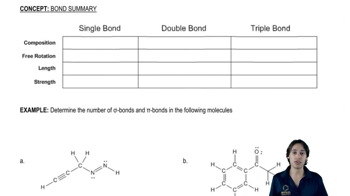
The polarity of a bond refers to the distribution of electrical charge across the bond due to differences in electronegativity between the two atoms involved. A polar bond occurs when one atom is more electronegative than the other, leading to an unequal sharing of electrons. In the given examples, the H3C—Br bond is polar due to bromine's higher electronegativity compared to carbon, while the H3C—Li bond is less polar, as lithium has a significantly lower electronegativity than carbon.
Recommended video:
Guided course
06:00
Single bonds, double bonds, and triple bonds.