Ch. 10 - Reactions of Alcohols, Ethers, Epoxides, Amines, and Sulfur-Containing Compounds
Bruice - Organic Chemistry 8th Edition
Bruice8th EditionOrganic ChemistryISBN: 9780135213711Not the one you use?Change textbook
Chapter 11, Problem 96b

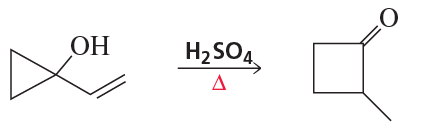
Propose a mechanism for each of the following reactions:
b. Chemical reaction diagram illustrating a dehydration reaction with an alcohol, sulfuric acid, and a carbonyl compound.

Verified step by step guidance
1
Step 1: Protonation of the alcohol group - The reaction begins with the protonation of the hydroxyl (-OH) group by sulfuric acid (H₂SO₄). This converts the alcohol into a better leaving group, forming a positively charged oxonium ion.
Step 2: Formation of a carbocation - The protonated alcohol group leaves as water (H₂O), resulting in the formation of a carbocation at the tertiary carbon. This step is facilitated by the stability of the tertiary carbocation.
Step 3: Ring expansion - The carbocation undergoes a ring expansion to relieve ring strain in the cyclopentane ring. A hydride shift or alkyl shift occurs, leading to the formation of a more stable cyclohexane ring structure.
Step 4: Elimination to form the double bond - A proton is abstracted from a neighboring carbon by the conjugate base of sulfuric acid (HSO₄⁻), resulting in the formation of a double bond. This step completes the formation of the alkene product.
Step 5: Final product - The final product is a cyclohexene derivative with a double bond and a methyl group attached to the ring. This is the result of the elimination reaction and ring expansion.

Verified video answer for a similar problem:

This video solution was recommended by our tutors as helpful for the problem above.
Video duration:
5m
Was this helpful?

Key Concepts

Here are the essential concepts you must grasp in order to answer the question correctly.

Dehydration Reaction

A dehydration reaction involves the removal of a water molecule from a compound, typically resulting in the formation of a double bond. In organic chemistry, this process is often used to convert alcohols into alkenes. The reaction is facilitated by strong acids, such as sulfuric acid, which protonate the alcohol, making it a better leaving group.
Recommended video:
Guided course
01:23
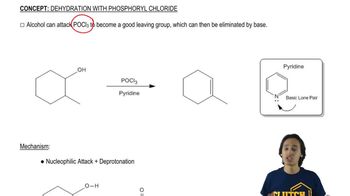
General Reaction of Dehydration with POCl3

Protonation and Carbocation Formation

In the presence of sulfuric acid, the hydroxyl group of the alcohol is protonated, leading to the formation of a carbocation intermediate. This step is crucial as it increases the electrophilicity of the molecule, allowing for the subsequent elimination of water. The stability of the carbocation significantly influences the reaction pathway and the final product.
Recommended video:
Guided course
07:21
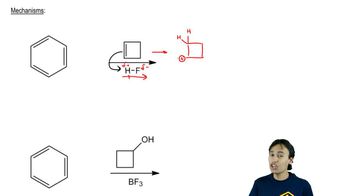
Any Carbocation

Elimination Mechanism (E1 or E2)

The elimination mechanism can occur via either E1 or E2 pathways. In the E1 mechanism, the reaction proceeds through a two-step process involving carbocation formation followed by the loss of a proton to form the alkene. In contrast, the E2 mechanism is a concerted process where the base abstracts a proton while the leaving group departs, resulting in the formation of the double bond in a single step.
Recommended video:
Guided course
09:36
Drawing the E2 Mechanism.