Ch. 10 - Reactions of Alcohols, Ethers, Epoxides, Amines, and Sulfur-Containing Compounds
Bruice - Organic Chemistry 8th Edition
Bruice8th EditionOrganic ChemistryISBN: 9780135213711Not the one you use?Change textbook
Chapter 11, Problem 94

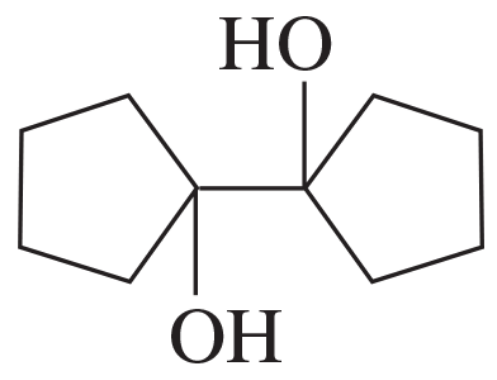
What product is obtained when the following vicinal diol is heated in an acidic solution?

Verified step by step guidance
1
Identify the functional group in the molecule: The given compound is a vicinal diol, which means it has two hydroxyl (-OH) groups on adjacent carbon atoms.
Recall the reaction mechanism: When a vicinal diol is heated in an acidic solution, it undergoes a pinacol rearrangement. This reaction involves the migration of a substituent group and the formation of a ketone or aldehyde.
Protonation of one hydroxyl group: In the acidic solution, one of the hydroxyl groups is protonated, making it a better leaving group. This step generates a carbocation intermediate after the loss of water (H₂O).
Analyze the carbocation stability: The carbocation formed will rearrange to stabilize itself. In this case, the migration of one of the cyclopentyl groups occurs to stabilize the carbocation, leading to a new intermediate structure.
Formation of the final product: After the rearrangement, a ketone is formed as the final product. The carbonyl group (C=O) will be located on the carbon atom that originally had the hydroxyl group.

Verified video answer for a similar problem:

This video solution was recommended by our tutors as helpful for the problem above.
Video duration:
7m
Was this helpful?

Key Concepts

Here are the essential concepts you must grasp in order to answer the question correctly.

Vicinal Diols

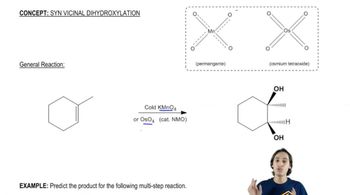
Vicinal diols, also known as glycols, are organic compounds that contain two hydroxyl (-OH) groups attached to adjacent carbon atoms. Their structure allows for unique reactivity, particularly under acidic conditions, where they can undergo dehydration to form more stable products. Understanding the structure and properties of vicinal diols is essential for predicting their behavior in chemical reactions.
Recommended video:
Guided course
03:50
General properties of syn vicinal dihydroxylation.

Acid-Catalyzed Dehydration

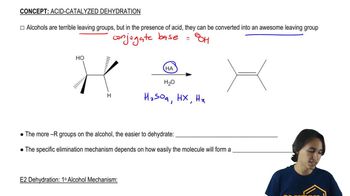
Acid-catalyzed dehydration is a reaction where an alcohol or diol loses a water molecule in the presence of an acid, leading to the formation of alkenes or ethers. In the case of vicinal diols, heating in acidic conditions typically promotes the elimination of water, resulting in the formation of a more stable alkene. This process is crucial for understanding how diols can be transformed into other functional groups.
Recommended video:
Guided course
06:01
General features of acid-catalyzed dehydration.

Carbocation Stability

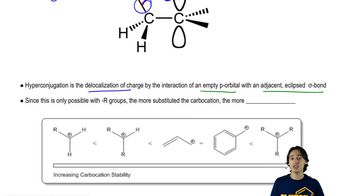
Carbocation stability refers to the relative stability of positively charged carbon species that form during reactions such as dehydration. The stability of a carbocation is influenced by factors such as the degree of substitution (primary, secondary, tertiary) and resonance effects. Recognizing the stability of potential carbocations formed during the dehydration of vicinal diols is key to predicting the major product of the reaction.
Recommended video:
Guided course
05:58
Determining Carbocation Stability