
Ch. 11 - Organometallic Compounds
Bruice - Organic Chemistry 8th Edition
Bruice8th EditionOrganic ChemistryISBN: 9780135213711Not the one you use?Change textbook
Chapter 12, Problem 57a(6)

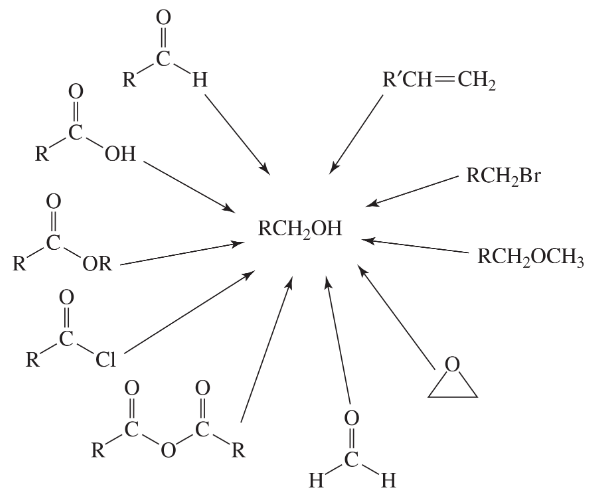
a. Show the reagents required to form the primary alcohol in each of the following reactions.

Verified step by step guidance
1
Step 1: Identify the starting material and the product. The starting material is an aldehyde (ethanal, CH₃CHO), and the product is a primary alcohol (ethanol, CH₃CH₂OH).
Step 2: Recognize the type of reaction. This is a reduction reaction where the aldehyde is reduced to a primary alcohol.
Step 3: Select the appropriate reducing agent. Common reducing agents for this transformation include sodium borohydride (NaBH₄) or lithium aluminum hydride (LiAlH₄).
Step 4: Consider the reaction conditions. NaBH₄ is typically used in protic solvents like ethanol or water, while LiAlH₄ requires anhydrous conditions and is often used in ether solvents such as diethyl ether.
Step 5: Write the reaction mechanism. The reducing agent donates hydride ions (H⁻) to the carbonyl carbon of the aldehyde, breaking the C=O double bond and forming the primary alcohol.

Verified video answer for a similar problem:

This video solution was recommended by our tutors as helpful for the problem above.
Video duration:
4m
Was this helpful?

Key Concepts

Here are the essential concepts you must grasp in order to answer the question correctly.

Carbonyl Compounds

Carbonyl compounds contain a carbon atom double-bonded to an oxygen atom (C=O). They are classified into aldehydes and ketones, depending on the carbonyl's position in the molecule. Aldehydes, like the one shown in the reaction, have at least one hydrogen atom attached to the carbonyl carbon, making them more reactive in nucleophilic addition reactions.
Recommended video:
Guided course
01:40
Defining meso compounds.

Nucleophilic Addition

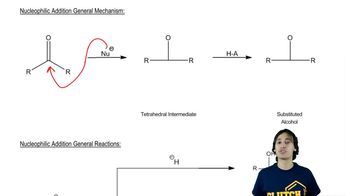
Nucleophilic addition is a fundamental reaction mechanism in organic chemistry where a nucleophile attacks an electrophilic carbon atom, such as that in a carbonyl group. This reaction typically leads to the formation of alcohols when the carbonyl compound is reduced. In the context of the question, a nucleophile will add to the carbonyl carbon, resulting in the formation of a primary alcohol.
Recommended video:
Guided course
08:27
Nucleophilic Addition

Reagents for Alcohol Formation

To convert a carbonyl compound into a primary alcohol, specific reagents are required. Commonly, lithium aluminum hydride (LiAlH4) or sodium borohydride (NaBH4) are used as reducing agents. These reagents donate hydride ions (H-) to the carbonyl carbon, effectively reducing it and resulting in the formation of a primary alcohol.
Recommended video: