a. Show the reagents required to form the primary alcohol in each of the following reactions.
Ch. 11 - Organometallic Compounds
Chapter 12, Problem 73a,b
What are the products of the following reactions? Show all stereoisomers that are formed.
a. 
b. 
Verified step by step guidance1
Step 1: Analyze the first reaction. The reagent (CH3)2CuLi is a Gilman reagent, which is used for conjugate addition to α,β-unsaturated ketones. The ketone in the structure has a double bond conjugated to the carbonyl group. The Gilman reagent will add a methyl group to the β-carbon of the conjugated system.
Step 2: After the conjugate addition, the intermediate formed will have the methyl group added to the β-carbon. The carbonyl group remains intact. The second step involves EtOH, which serves as a proton source to stabilize the intermediate.
Step 3: Consider stereochemistry for the first reaction. Since the addition occurs at the β-carbon, stereoisomers may form depending on the spatial arrangement of the substituents. Analyze the possible configurations (R/S or cis/trans) for the product.
Step 4: Analyze the second reaction. The reagent CH3MgBr is a Grignard reagent, which reacts with the carbonyl group of the ketone. The Grignard reagent adds a methyl group to the carbonyl carbon, converting the ketone into an alcohol.
Step 5: Consider stereochemistry for the second reaction. The addition of the methyl group to the carbonyl carbon creates a new chiral center. Analyze the possible stereoisomers (R/S configurations) for the alcohol product formed after protonation with H3O+.

Verified video answer for a similar problem:
This video solution was recommended by our tutors as helpful for the problem above.
Video duration:
7mWas this helpful?
Key Concepts
Here are the essential concepts you must grasp in order to answer the question correctly.
Stereoisomerism
Stereoisomerism refers to the phenomenon where compounds have the same molecular formula and connectivity of atoms but differ in the spatial arrangement of their atoms. This can lead to different physical and chemical properties. Understanding stereoisomers is crucial for predicting the outcomes of reactions, especially in organic chemistry, where the 3D orientation of molecules can significantly affect reactivity and product formation.
Recommended video:
Guided course
Determining when molecules are stereoisomers.
Reaction Mechanisms
A reaction mechanism is a step-by-step description of how reactants transform into products during a chemical reaction. It includes details about the breaking and forming of bonds, the intermediates formed, and the transition states. Analyzing the mechanism helps in predicting the products and understanding the stereochemical outcomes, including the formation of stereoisomers.
Recommended video:
Guided course
Heck Reaction Mechanism
Chirality
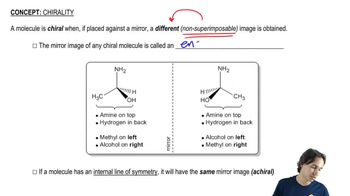
Chirality is a property of a molecule that makes it non-superimposable on its mirror image, much like left and right hands. Chiral molecules often have one or more stereocenters, which are carbon atoms bonded to four different substituents. Recognizing chirality is essential for determining the specific stereoisomers produced in reactions, as different stereoisomers can have vastly different biological activities and properties.
Recommended video:
Guided course
What is chirality?
Related Practice
Textbook Question
1135
views
Textbook Question
The Reformatsky reaction is an addition reaction in which an organozinc reagent is used instead of a Grignard reagent to add to the carbonyl group of an aldehyde or a ketone. Because the organozinc reagent is less reactive than a Grignard reagent, a nucleophilic addition to the ester group does not occur.
The organozinc reagent is prepared by treating an α-bromo ester with zinc.
Describe how each of the following compounds can be prepared, using a Reformatsky reaction:
d.
1588
views
Textbook Question
What product is obtained from ring-opening metathesis polymerization of each of the following compounds? (Hint: In each case, the product is an unsaturated hydrocarbon with a high molecular weight.)
a.
1033
views