Ch. 12 - Radicals
Bruice - Organic Chemistry 8th Edition
Bruice8th EditionOrganic ChemistryISBN: 9780135213711Not the one you use?Change textbook
Chapter 13, Problem 22a(1,2)

Draw the major product(s) of the reaction of 1-methylcyclohexene with the following reagents, disregarding stereoisomers:
1. NBS/∆/peroxide
2. Br2/CH2Cl2

Verified step by step guidance
1
Step 1: Analyze the first reaction with NBS (N-Bromosuccinimide), heat (∆), and peroxide. This is a bromination reaction that occurs at the allylic position of the alkene. Identify the allylic positions in 1-methylcyclohexene, which are the carbons adjacent to the double bond.
Step 2: Determine the most stable allylic radical intermediate. The peroxide initiates a radical chain reaction, and the bromine radical from NBS will abstract a hydrogen atom from the allylic position, forming the most stable allylic radical. Consider resonance structures to identify the most stable radical.
Step 3: Add a bromine atom to the allylic radical to form the product of the first reaction. The major product will be the one where bromine is added to the most stable allylic position.
Step 4: Analyze the second reaction with Br₂ in CH₂Cl₂. This is an electrophilic addition reaction to the double bond of 1-methylcyclohexene. The bromine molecule will add across the double bond, forming a vicinal dibromide (two bromine atoms on adjacent carbons).
Step 5: Combine the results of both reactions. The first reaction gives an allylic bromination product, while the second reaction gives a dibrominated product. Draw the structures of the major products for each reaction, ensuring to account for the regioselectivity and the type of reaction mechanism involved.

Verified video answer for a similar problem:

This video solution was recommended by our tutors as helpful for the problem above.
Video duration:
10m
Was this helpful?

Key Concepts

Here are the essential concepts you must grasp in order to answer the question correctly.

Electrophilic Addition Reactions

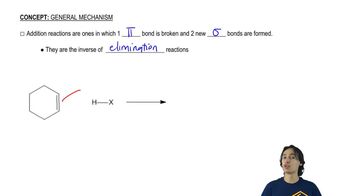
Electrophilic addition reactions are a fundamental type of reaction in organic chemistry where an electrophile reacts with a nucleophile, typically involving alkenes. In the case of 1-methylcyclohexene, the double bond acts as a nucleophile, allowing electrophiles like bromine or N-bromosuccinimide (NBS) to add across the double bond, leading to the formation of new products.
Recommended video:
Guided course
05:39
Features of Addition Mechanisms.

Radical Mechanism

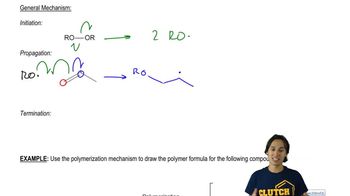
The radical mechanism is a reaction pathway that involves the formation of free radicals, which are highly reactive species with unpaired electrons. In the presence of NBS and heat (∆), a bromine radical is generated, which can abstract a hydrogen atom from the alkene, leading to the formation of a brominated product. Understanding this mechanism is crucial for predicting the products of the reaction.
Recommended video:
Guided course
03:28
The mechanism of Radical Polymerization.

Bromination of Alkenes

Bromination of alkenes is a specific type of electrophilic addition where bromine (Br2) adds across the double bond of an alkene. This reaction typically occurs in a non-polar solvent like dichloromethane (CH2Cl2) and results in the formation of vicinal dibromides. Recognizing the regioselectivity and stereochemistry of this reaction is important for determining the major product formed from 1-methylcyclohexene.
Recommended video:
Guided course
00:54
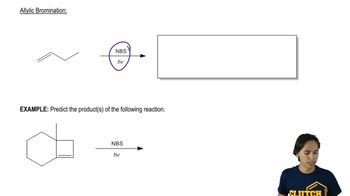
Mechanism of Allylic Bromination.