Ch. 12 - Radicals
Bruice - Organic Chemistry 8th Edition
Bruice8th EditionOrganic ChemistryISBN: 9780135213711Not the one you use?Change textbook
Chapter 13, Problem 21d

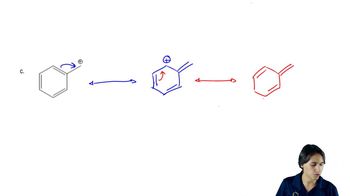
Draw the resonance contributors for the following radicals:
d.

Verified step by step guidance
1
Identify the radical center in the given structure. A radical is typically represented by a single unpaired electron on an atom, often carbon.
Determine if there are any adjacent atoms with lone pairs or π bonds that can participate in resonance. These are typically atoms like oxygen, nitrogen, or carbon-carbon double bonds.
Draw the first resonance structure by moving electrons. Use curved arrows to show the movement of electrons: a single-headed arrow indicates the movement of a single electron.
Continue to draw additional resonance structures by moving electrons to different positions, ensuring that each structure adheres to the rules of valency and maintains the radical character.
Verify that all resonance structures are valid by checking that the total number of electrons remains constant and that each structure contributes to the overall hybrid by stabilizing the radical through delocalization.

Verified video answer for a similar problem:

This video solution was recommended by our tutors as helpful for the problem above.
Video duration:
6m
Was this helpful?

Key Concepts

Here are the essential concepts you must grasp in order to answer the question correctly.

Resonance Structures

Resonance structures are different Lewis structures for the same molecule that depict the same arrangement of atoms but differ in the placement of electrons. These structures help illustrate the delocalization of electrons within a molecule, which can stabilize the overall structure. Understanding resonance is crucial for predicting the reactivity and stability of radicals, as it shows how electron density can be distributed across different atoms.
Recommended video:
Guided course
03:04
Drawing Resonance Structures

Radicals

Radicals are species that contain an unpaired electron, making them highly reactive. They can be formed through various processes, such as homolytic bond cleavage. In the context of resonance, radicals can have multiple resonance contributors, which can help stabilize the radical by delocalizing the unpaired electron across different atoms, thus lowering the overall energy of the molecule.
Recommended video:
1:30
Radical Polymerization Concept 4

Electron Delocalization

Electron delocalization refers to the spreading of electron density across multiple atoms in a molecule, rather than being localized between two atoms. This phenomenon is a key feature of resonance and contributes to the stability of radicals and other reactive intermediates. By understanding how electrons can be shared among different atoms, one can better predict the behavior and reactivity of organic compounds.
Recommended video:
Guided course
03:54
The 18 and 16 Electron Rule