Ch. 12 - Radicals
Bruice - Organic Chemistry 8th Edition
Bruice8th EditionOrganic ChemistryISBN: 9780135213711Not the one you use?Change textbook
Chapter 13, Problem 24

How many atoms share the unpaired electron in semiquinone?
Chemical structure of semiquinone showing unpaired electron and atom connections.

Verified step by step guidance
1
Step 1: Recognize the structure of semiquinone. Semiquinone is a radical species derived from quinones, where one of the oxygen atoms has an unpaired electron. The structure provided shows a benzene ring with an oxygen atom attached, carrying an unpaired electron.
Step 2: Understand the delocalization of the unpaired electron. In semiquinone, the unpaired electron is not localized on the oxygen atom alone but is delocalized over the conjugated π-system of the benzene ring and the oxygen atom.
Step 3: Analyze the conjugated system. The benzene ring has alternating double bonds, which form a conjugated π-system. The oxygen atom is connected to the ring, allowing the unpaired electron to interact with the π-system.
Step 4: Determine the atoms involved in delocalization. The delocalization occurs over the oxygen atom and the carbon atoms of the benzene ring that are part of the conjugated π-system. This includes the oxygen atom and six carbon atoms of the benzene ring.
Step 5: Conclude the number of atoms sharing the unpaired electron. The unpaired electron is shared among seven atoms: the oxygen atom and the six carbon atoms of the benzene ring.

Verified video answer for a similar problem:

This video solution was recommended by our tutors as helpful for the problem above.
Video duration:
6m
Was this helpful?

Key Concepts

Here are the essential concepts you must grasp in order to answer the question correctly.

Radicals

Radicals are species that contain unpaired electrons, making them highly reactive. In organic chemistry, they often participate in various reactions, including addition and substitution. Understanding the nature of radicals is crucial for analyzing their stability and reactivity, particularly in compounds like semiquinone, which features an unpaired electron.
Recommended video:
1:30
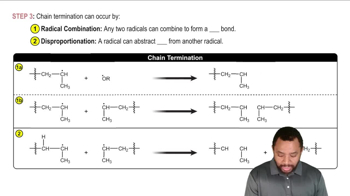
Radical Polymerization Concept 4

Semiquinone Structure

Semiquinones are a class of organic compounds derived from quinones, characterized by having one unpaired electron. This unpaired electron can be localized on one of the carbon atoms in the ring structure, influencing the compound's chemical behavior. Recognizing the specific atom that holds the unpaired electron is essential for understanding the properties and reactivity of semiquinones.
Recommended video:
Guided course
03:04
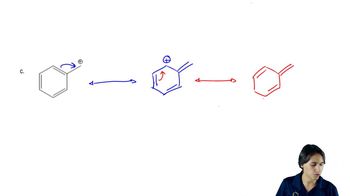
Drawing Resonance Structures

Electron Delocalization

Electron delocalization refers to the distribution of electrons across multiple atoms in a molecule, which can stabilize radicals and influence their reactivity. In semiquinones, the unpaired electron may be delocalized over the aromatic ring, affecting the overall stability and reactivity of the compound. This concept is vital for predicting how semiquinones will interact in chemical reactions.
Recommended video:
Guided course
03:54
The 18 and 16 Electron Rule