Ch. 12 - Radicals
Bruice - Organic Chemistry 8th Edition
Bruice8th EditionOrganic ChemistryISBN: 9780135213711Not the one you use?Change textbook
Chapter 13, Problem 26d

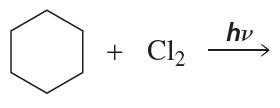
What are the product(s) of each of the following reactions? Disregard stereoisomers.
d. Hexagonal structure of cyclohexane reacting with chlorine gas under light to form products.

Verified step by step guidance
1
Step 1: Recognize the type of reaction. The presence of Cl₂ and light (hv) indicates a free radical halogenation reaction, specifically chlorination.
Step 2: Understand the mechanism. Free radical halogenation involves three steps: initiation, propagation, and termination. In the initiation step, light energy breaks the Cl-Cl bond to form two chlorine radicals.
Step 3: Identify the substrate. The substrate is cyclopentane, a cyclic alkane. Free radical halogenation will occur at one of the hydrogen atoms attached to the carbon atoms in the ring.
Step 4: Predict the product formation. Chlorine radicals will abstract a hydrogen atom from cyclopentane, forming a cyclopentyl radical. This radical will then react with another chlorine molecule to form chlorocyclopentane.
Step 5: Consider regioselectivity. Since all hydrogens in cyclopentane are equivalent, the chlorination will produce a single product, chlorocyclopentane, disregarding stereoisomers.

Verified video answer for a similar problem:

This video solution was recommended by our tutors as helpful for the problem above.
Video duration:
3m
Was this helpful?

Key Concepts

Here are the essential concepts you must grasp in order to answer the question correctly.

Free Radical Halogenation

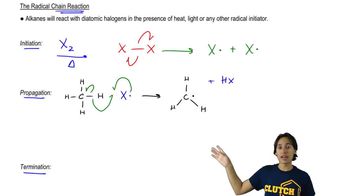
Free radical halogenation is a reaction mechanism where alkanes or cycloalkanes react with halogens (like Cl2) in the presence of light or heat, leading to the substitution of hydrogen atoms with halogen atoms. This process involves the formation of free radicals, which are highly reactive species that drive the reaction forward through a series of chain reactions.
Recommended video:
Guided course
12:11
Radical Chain Reaction Mechanism.

Mechanism of Chlorination

The chlorination of cyclohexane involves three main steps: initiation, propagation, and termination. In the initiation step, Cl2 is dissociated into two chlorine radicals under light. During propagation, these radicals react with cyclohexane to form chlorinated products and regenerate more radicals. The reaction continues until termination occurs, where two radicals combine to form a stable product.
Recommended video:
Guided course
00:48
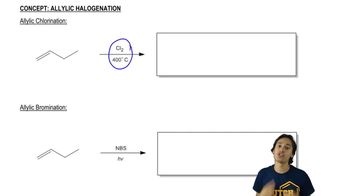
The products of Allylic Chlorination.

Product Distribution and Reactivity

The distribution of products in the chlorination of cyclohexane depends on the stability of the free radicals formed during the reaction. Secondary and tertiary radicals are more stable than primary radicals, leading to a higher likelihood of substitution at these positions. However, since the question specifies to disregard stereoisomers, the focus will be on the overall types of chlorinated products formed, such as mono- and poly-chlorinated derivatives.
Recommended video:
Guided course
11:07
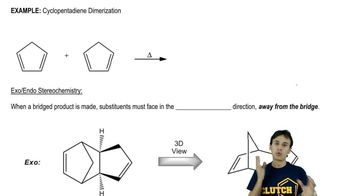
Bridged-Products