Ch. 13 - Mass Spectrometry; Infrared Spectroscopy; UV/Vis Spectroscopy
Bruice - Organic Chemistry 8th Edition
Bruice8th EditionOrganic ChemistryISBN: 9780135213711Not the one you use?Change textbook
Chapter 14, Problem 6b

Can one of the possible molecular formulas contain a nitrogen atom?

Verified step by step guidance
1
Step 1: Recall the general rules for determining molecular formulas. A molecular formula represents the actual number of atoms of each element in a molecule. It must satisfy the rules of valency and the octet rule for all atoms involved.
Step 2: Consider the presence of nitrogen in a molecule. Nitrogen typically forms three covalent bonds and has one lone pair of electrons, following its valency of 3. This is important when determining if a molecular formula can include nitrogen.
Step 3: Analyze the molecular formula in question (if provided) or the context of the problem. Check if the inclusion of nitrogen would allow the molecule to satisfy the octet rule for all atoms and maintain a valid structure.
Step 4: Verify the molecular formula's consistency with the rules of stoichiometry and the presence of nitrogen. For example, if the molecular formula includes nitrogen, ensure that the total number of bonds and atoms aligns with the expected structure.
Step 5: Conclude whether a nitrogen atom can be included in the molecular formula based on the above analysis. If the molecular formula can accommodate nitrogen while satisfying all chemical rules, then it is possible for nitrogen to be part of the molecule.

Verified video answer for a similar problem:

This video solution was recommended by our tutors as helpful for the problem above.
Video duration:
2m
Was this helpful?

Key Concepts

Here are the essential concepts you must grasp in order to answer the question correctly.

Molecular Formula

A molecular formula represents the number and types of atoms in a molecule. It is expressed using chemical symbols and subscripts, indicating how many of each atom are present. Understanding molecular formulas is crucial for determining the composition of a compound and predicting its properties.
Recommended video:
Guided course
02:17
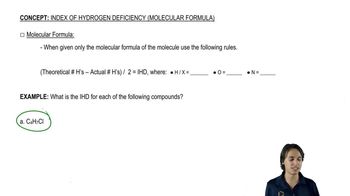
How to use IHD with molecular formula.

Nitrogen in Organic Compounds

Nitrogen is a common element in organic chemistry, often found in amines, amides, and other functional groups. Its presence can significantly affect the reactivity and properties of organic molecules. Recognizing how nitrogen can be incorporated into molecular formulas is essential for understanding the diversity of organic compounds.
Recommended video:
Guided course
01:40
Defining meso compounds.

Valency and Bonding

Valency refers to the ability of an atom to bond with other atoms, determined by the number of electrons in its outer shell. Nitrogen typically has a valency of three, allowing it to form three covalent bonds. This concept is fundamental for constructing molecular formulas and understanding how different atoms, including nitrogen, can combine in organic molecules.
Recommended video:
Guided course
02:14
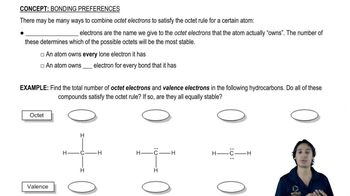
What is a valence electron?