Ch. 13 - Mass Spectrometry; Infrared Spectroscopy; UV/Vis Spectroscopy
Bruice - Organic Chemistry 8th Edition
Bruice8th EditionOrganic ChemistryISBN: 9780135213711Not the one you use?Change textbook
Chapter 14, Problem 9

Predict the relative intensities of the molecular ion peak, the M+2 peak, and the M+4 peak for a compound that contains two bromine atoms.

Verified step by step guidance
1
Understand the isotopic composition of bromine: Bromine has two naturally occurring isotopes, Br-79 and Br-81, with approximately equal abundances (about 50% each). This means that for a molecule containing bromine, the molecular ion peak (M), M+2, and M+4 peaks will arise from different combinations of these isotopes.
Determine the possible combinations of isotopes for two bromine atoms: The combinations are Br-79/Br-79, Br-79/Br-81, and Br-81/Br-81. These combinations will contribute to the M, M+2, and M+4 peaks, respectively.
Calculate the relative probabilities of each combination: Since each bromine isotope has a 50% abundance, the probability of Br-79/Br-79 is (0.5 × 0.5 = 0.25), the probability of Br-79/Br-81 is (0.5 × 0.5 = 0.25) for each arrangement (two arrangements are possible: Br-79/Br-81 and Br-81/Br-79, so total = 0.25 + 0.25 = 0.5), and the probability of Br-81/Br-81 is (0.5 × 0.5 = 0.25).
Relate the probabilities to peak intensities: The relative intensities of the peaks will correspond to the probabilities of the isotope combinations. The M peak (Br-79/Br-79) will have an intensity proportional to 0.25, the M+2 peak (Br-79/Br-81) will have an intensity proportional to 0.5, and the M+4 peak (Br-81/Br-81) will have an intensity proportional to 0.25.
Express the relative intensities as a ratio: Based on the probabilities, the relative intensities of the M, M+2, and M+4 peaks will be in the ratio 1:2:1. This reflects the statistical distribution of the bromine isotopes in the molecule.

Verified video answer for a similar problem:

This video solution was recommended by our tutors as helpful for the problem above.
Video duration:
5m
Was this helpful?

Key Concepts

Here are the essential concepts you must grasp in order to answer the question correctly.

Molecular Ion Peak (M+ Peak)

The molecular ion peak, denoted as M+, represents the ion formed by the removal of one electron from the neutral molecule. It provides information about the molecular weight of the compound. In mass spectrometry, this peak is crucial for identifying the molecular formula of the compound being analyzed.
Recommended video:
Guided course
09:26
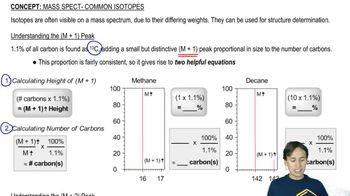
The (M + 1) Peak

Isotope Patterns

Isotope patterns arise from the presence of naturally occurring isotopes of elements within a molecule. For bromine, which has two stable isotopes (Br-79 and Br-81), the M+2 peak corresponds to the molecular ion formed when one of the bromine atoms is the heavier isotope. This results in a characteristic ratio of M, M+2, and M+4 peaks in the mass spectrum.
Recommended video:
Guided course
08:06
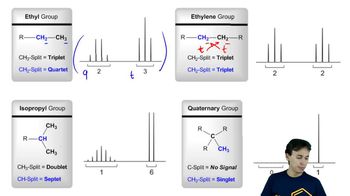
Common Splitting Patterns

Relative Intensities in Mass Spectrometry

Relative intensities in mass spectrometry refer to the comparative abundance of different ion peaks in the spectrum. The intensity of the M+2 peak for a compound with two bromine atoms will be higher than that of a compound with one bromine atom due to the increased likelihood of detecting the heavier isotopes. The M+4 peak will be significantly less intense, as it represents a less probable combination of isotopes.
Recommended video:
Guided course
01:25
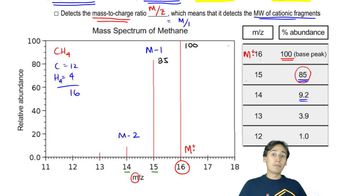
How to Read a Mass Spectrum