Ch. 13 - Mass Spectrometry; Infrared Spectroscopy; UV/Vis Spectroscopy
Bruice - Organic Chemistry 8th Edition
Bruice8th EditionOrganic ChemistryISBN: 9780135213711Not the one you use?Change textbook
Chapter 14, Problem 56

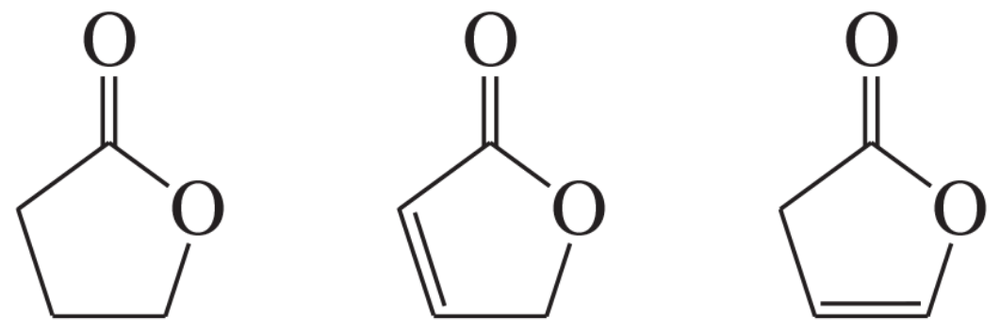
Rank the following compounds from highest wavenumber to lowest wavenumber for their C-O absorption band:

Verified step by step guidance
1
Step 1: Identify the functional groups in each compound. All three compounds contain a carbonyl group (C=O) and an ether group (C-O). The first compound is a simple ester, the second compound is an α,β-unsaturated ester (conjugated with a double bond), and the third compound is an ester conjugated with an aromatic ring.
Step 2: Understand the factors affecting the wavenumber of the C=O absorption band. The wavenumber is influenced by resonance effects, conjugation, and the electronic environment around the carbonyl group. Conjugation lowers the wavenumber due to delocalization of electrons, reducing the bond strength of the C=O.
Step 3: Compare the conjugation effects in the compounds. The first compound has no conjugation, so its C=O bond is the strongest and will absorb at the highest wavenumber. The second compound has conjugation with an alkene, which lowers the wavenumber. The third compound has conjugation with an aromatic ring, which further lowers the wavenumber due to stronger resonance effects.
Step 4: Rank the compounds based on the expected wavenumber of their C=O absorption band. The order from highest to lowest wavenumber is: Compound 1 (no conjugation), Compound 2 (conjugation with alkene), Compound 3 (conjugation with aromatic ring).
Step 5: Note that the C-O absorption band is also influenced by the electronic environment, but the ranking primarily depends on the conjugation effects on the C=O bond.

Verified video answer for a similar problem:

This video solution was recommended by our tutors as helpful for the problem above.
Video duration:
11m
Was this helpful?

Key Concepts

Here are the essential concepts you must grasp in order to answer the question correctly.

Infrared Spectroscopy (IR)

Infrared spectroscopy is a technique used to identify molecular structures by measuring the absorption of infrared light, which causes molecular vibrations. Different functional groups absorb IR radiation at characteristic wavenumbers, allowing chemists to deduce the presence of specific bonds, such as C-O bonds in this case.
Recommended video:
Guided course
16:04
General Features of IR Spect

Wavenumber and Bond Strength

Wavenumber, measured in cm⁻¹, is inversely related to the wavelength of light and is commonly used in IR spectroscopy. Generally, stronger bonds absorb at higher wavenumbers; thus, the C-O bond strength and the presence of electron-withdrawing groups can influence the wavenumber of the absorption band.
Recommended video:
Guided course
06:00
Single bonds, double bonds, and triple bonds.

Effects of Substituents on C-O Bonds

The presence of different substituents on a carbon atom can significantly affect the C-O bond's characteristics. Electron-withdrawing groups increase the bond polarity and strength, leading to higher wavenumber absorption, while electron-donating groups can lower the wavenumber due to decreased bond strength.
Recommended video:
3:26
Directing Effects in Substituted Pyrroles, Furans, and Thiophenes Concept 2