Ch. 13 - Mass Spectrometry; Infrared Spectroscopy; UV/Vis Spectroscopy
Bruice - Organic Chemistry 8th Edition
Bruice8th EditionOrganic ChemistryISBN: 9780135213711Not the one you use?Change textbook
Chapter 14, Problem 58b

The mass spectrum for a compound with molecular weight of 102 is shown below. Its IR spectrum has a broad, strong absorption at 3600 cm–1 and a medium absorption at 1360 cm–1.
b. Show the mechanism for formation of the peak at m/z = 84.
<IMAGE>

Verified step by step guidance
1
Analyze the molecular weight of the compound (102) and the IR spectrum data. The broad, strong absorption at 3600 cm⁻¹ suggests the presence of an -OH group (alcohol or phenol). The medium absorption at 1360 cm⁻¹ indicates possible C-H bending vibrations, often associated with methyl groups.
Identify the base structure of the compound. Given the molecular weight and functional group information, hypothesize a structure that includes an alcohol group (-OH) and possibly a methyl group.
Determine the fragment responsible for the m/z = 84 peak. Subtract the mass of the fragment lost from the molecular ion (102 - 84 = 18). A mass of 18 corresponds to the loss of a water molecule (H₂O), which is common in alcohol-containing compounds.
Propose a mechanism for the formation of the m/z = 84 peak. The loss of H₂O can occur via a dehydration reaction. This involves the -OH group and a hydrogen atom from a neighboring carbon atom, forming a double bond in the process. Use curved arrows to show the movement of electrons: (1) the lone pair on the oxygen of the -OH group abstracts a proton, (2) the bond between the oxygen and carbon breaks, and (3) a double bond forms between adjacent carbons.
Verify the stability of the resulting fragment (m/z = 84). The fragment should be a stable carbocation or neutral molecule, depending on the specific structure of the compound. Ensure that the proposed mechanism aligns with the observed mass spectrum and IR data.

Verified video answer for a similar problem:

This video solution was recommended by our tutors as helpful for the problem above.
Video duration:
3m
Was this helpful?

Key Concepts

Here are the essential concepts you must grasp in order to answer the question correctly.

Mass Spectrometry

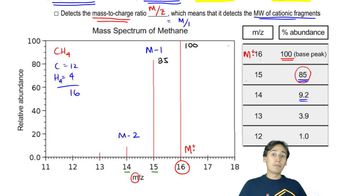
Mass spectrometry is an analytical technique used to measure the mass-to-charge ratio of ions. It helps identify the molecular weight of compounds and their fragmentation patterns. In this context, the peak at m/z = 84 indicates a specific fragment of the original molecule, which can provide insights into its structure and functional groups.
Recommended video:
Guided course
01:25
How to Read a Mass Spectrum

Infrared (IR) Spectroscopy

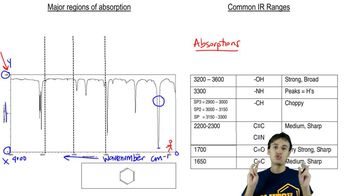
Infrared spectroscopy is a technique that measures the absorption of infrared light by a compound, providing information about its molecular vibrations and functional groups. The broad absorption at 3600 cm–1 suggests the presence of an -OH group, while the medium absorption at 1360 cm–1 may indicate a C-H bending vibration, which can help deduce the compound's structure.
Recommended video:
Guided course
16:04
General Features of IR Spect

Fragmentation Mechanism

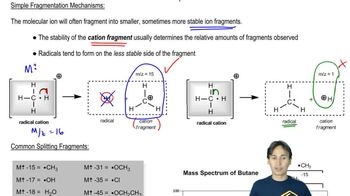
Fragmentation mechanisms describe how a molecule breaks apart during mass spectrometry, leading to the formation of smaller ions. Understanding these mechanisms is crucial for interpreting mass spectra, as they reveal how specific fragments, like the one at m/z = 84, are generated from the parent compound, often involving the cleavage of certain bonds or the loss of functional groups.
Recommended video:
Guided course
12:08
Simple Fragmentation Mechanisms
Related Practice
Textbook Question

Rank the following compounds from highest wavenumber to lowest wavenumber for their C=O absorption band:

1072
views

Textbook Question

The IR spectrum of compound A with a molecular formula of C5H12O is shown below. Compound A is oxidized to give compound B, a ketone with a molecular formula of C5H10O. When compound A is heated with H2SO4, compounds C and D are obtained. Considerably more D is obtained than C. Reaction of compound C with O3, followed by treatment with dimethyl sulfide, gives two products: formaldehyde and compound E, with a molecular formula of C4H8O. Reaction of compound D with O3, followed by treatment with dimethyl sulfide, gives two products: compound F, with a molecular formula of C3H6O, and compound G, with a molecular formula of C2H4O. What are the structures of compounds A through G?

<IMAGE>

1131
views
Textbook Question

Which one of the following five compounds produced the IR spectrum shown below?

<IMAGE>

1352
views
Textbook Question

Rank the following compounds from highest wavenumber to lowest wavenumber for their C-O absorption band:

1964
views
Textbook Question

The mass spectrum for a compound with molecular weight of 102 is shown below. Its IR spectrum has a broad, strong absorption at 3600 cm–1 and a medium absorption at 1360 cm–1.

a. Identify the compound.

<IMAGE>

1450
views
Textbook Question

Each of the IR spectra shown below is accompanied by a set of four compounds. In each case, indicate which of the four compounds is responsible for the spectrum.

a.

<IMAGE>

1260
views