Ch. 14 - NMR Spectroscopy
Bruice - Organic Chemistry 8th Edition
Bruice8th EditionOrganic ChemistryISBN: 9780135213711Not the one you use?Change textbook
Chapter 15, Problem 15a

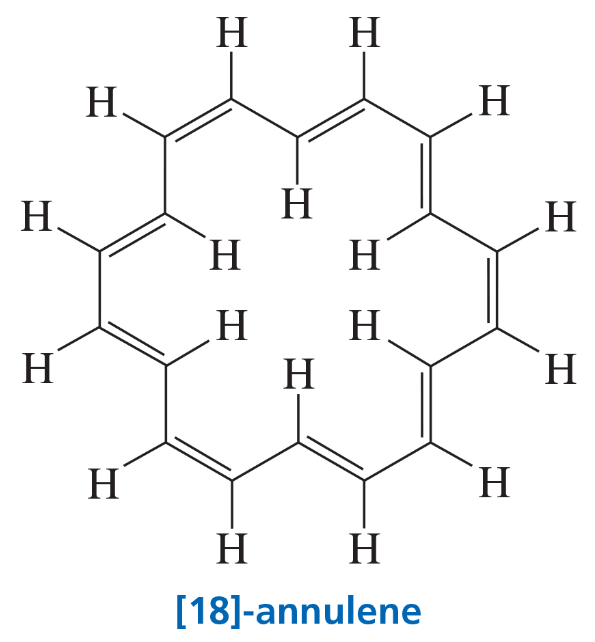
[18]-Annulene shows two signals in its 1H NMR spectrum: one at 9.25 ppm and the other to the right of the TMS signal at –2.88 ppm. What hydrogens are responsible for each of the signals? (Hint: Look at the direction of the induced magnetic field outside and inside the benzene ring in Figure 14.6.)

Verified step by step guidance
1
Understand the structure of [18]-annulene: It is a conjugated cyclic hydrocarbon with 18 π-electrons, making it aromatic according to Hückel's rule (4n+2 π-electrons, where n=4). The molecule has both interior and exterior hydrogens due to its large ring structure.
Recall the concept of aromatic ring currents: In aromatic systems, the π-electrons circulate under the influence of an external magnetic field, creating an induced magnetic field. This field has different effects on hydrogens located inside and outside the ring.
Analyze the induced magnetic field: Outside the ring, the induced magnetic field reinforces the external magnetic field, deshielding the hydrogens and causing their signals to appear downfield (higher ppm). Inside the ring, the induced magnetic field opposes the external field, shielding the hydrogens and causing their signals to appear upfield (lower ppm, even negative values).
Assign the signals: The signal at 9.25 ppm corresponds to the exterior hydrogens of [18]-annulene, as they are deshielded by the induced magnetic field. The signal at -2.88 ppm corresponds to the interior hydrogens, as they are shielded by the opposing induced magnetic field inside the ring.
Verify the reasoning: This pattern of chemical shifts is consistent with the aromaticity of [18]-annulene and the effects of the induced magnetic field on hydrogens located inside and outside the aromatic ring.

Verified video answer for a similar problem:

This video solution was recommended by our tutors as helpful for the problem above.
Video duration:
5m
Was this helpful?

Key Concepts

Here are the essential concepts you must grasp in order to answer the question correctly.

NMR Spectroscopy

Nuclear Magnetic Resonance (NMR) spectroscopy is a powerful analytical technique used to determine the structure of organic compounds. It relies on the magnetic properties of certain nuclei, such as hydrogen-1 (1H), which resonate at specific frequencies in a magnetic field. The chemical environment surrounding these nuclei affects their resonance frequency, leading to distinct signals in the NMR spectrum that correspond to different types of hydrogen atoms in a molecule.
Recommended video:
Guided course
10:06
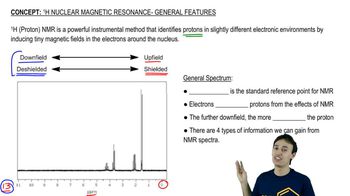
General NMR Features

Chemical Shift

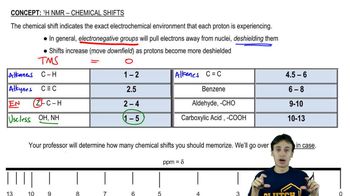
Chemical shift refers to the position of an NMR signal relative to a standard reference, typically tetramethylsilane (TMS). It is measured in parts per million (ppm) and provides insight into the electronic environment of the hydrogen atoms. For example, hydrogens attached to electron-withdrawing groups resonate at lower fields (higher ppm), while those near electron-donating groups resonate at higher fields (lower ppm), allowing chemists to infer structural information about the molecule.
Recommended video:
Guided course
11:44
1H NMR Chemical Shifts

Induced Magnetic Field

The induced magnetic field is a phenomenon that occurs when the presence of a magnetic field causes the electrons in a molecule to circulate, creating their own magnetic field. In the context of aromatic compounds like annulene, this effect can influence the local magnetic environment of hydrogen atoms. The direction of the induced magnetic field can either shield or deshield the hydrogen nuclei, affecting their chemical shifts in the NMR spectrum and helping to distinguish between different types of hydrogen environments.
Recommended video:
Guided course
10:06
General NMR Features