
[18]-Annulene shows two signals in its 1H NMR spectrum: one at 9.25 ppm and the other to the right of the TMS signal at –2.88 ppm. What hydrogens are responsible for each of the signals? (Hint: Look at the direction of the induced magnetic field outside and inside the benzene ring in Figure 14.6.)
Ch. 14 - NMR Spectroscopy
Chapter 15, Problem 14h
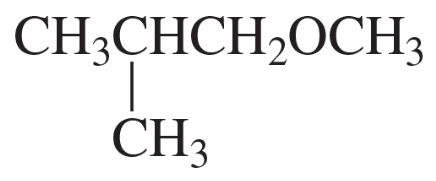
Without referring to Table 14.1, label the proton or set of protons in each compound that gives the signal at the lowest frequency a, at the next lowest b, and so on.
h. 
Verified step by step guidance1
Step 1: Analyze the structure of the molecule provided. The molecule contains a bromine atom attached to a CH2 group, which is connected to another CH2 group bonded to an oxygen atom. The oxygen atom is further bonded to a methyl group (CH3).
Step 2: Understand the concept of chemical shift in NMR spectroscopy. Protons in different chemical environments resonate at different frequencies due to the electronic environment around them. Electronegative atoms like bromine and oxygen deshield nearby protons, causing them to resonate at higher frequencies.
Step 3: Identify the protons in the molecule. There are three sets of protons: (1) the CH2 group attached to bromine, (2) the CH2 group attached to oxygen, and (3) the CH3 group attached to oxygen.
Step 4: Determine the relative chemical shifts. The CH2 group attached to bromine will resonate at the highest frequency due to the strong deshielding effect of bromine. The CH2 group attached to oxygen will resonate at the next highest frequency due to the deshielding effect of oxygen. The CH3 group attached to oxygen will resonate at the lowest frequency because it is less deshielded compared to the other groups.
Step 5: Assign labels based on frequency. Label the CH3 protons as 'a' (lowest frequency), the CH2 protons attached to oxygen as 'b' (next lowest frequency), and the CH2 protons attached to bromine as 'c' (highest frequency).

Verified video answer for a similar problem:
This video solution was recommended by our tutors as helpful for the problem above.
Video duration:
5mWas this helpful?
Key Concepts
Here are the essential concepts you must grasp in order to answer the question correctly.
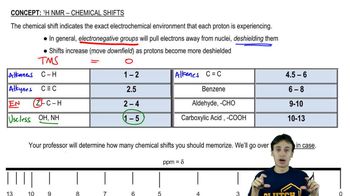
Chemical Shift in NMR Spectroscopy
In nuclear magnetic resonance (NMR) spectroscopy, the chemical shift refers to the resonance frequency of a nucleus relative to a standard in a magnetic field. It is influenced by the electronic environment surrounding the nucleus, with protons in electron-rich environments appearing at higher frequencies (lower ppm values) and those in electron-poor environments at lower frequencies (higher ppm values). Understanding chemical shifts is crucial for identifying the types of protons present in a compound.
Recommended video:
Guided course
1H NMR Chemical Shifts
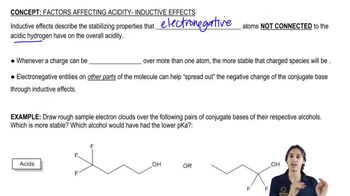
Electronegativity and Inductive Effect
Electronegativity is the tendency of an atom to attract electrons towards itself. In organic compounds, electronegative atoms (like Br or O) can withdraw electron density from nearby protons, affecting their chemical shift in NMR. This inductive effect can lead to downfield shifts (lower frequency) for protons adjacent to electronegative atoms, making it essential to consider when analyzing NMR spectra.
Recommended video:
Guided course
Understanding the Inductive Effect.
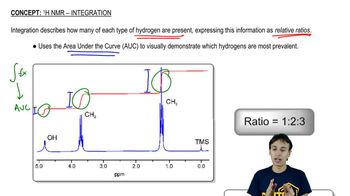
Integration and Multiplicity in NMR
Integration in NMR spectroscopy refers to the area under the peaks in the spectrum, which correlates to the number of protons contributing to that signal. Multiplicity indicates the splitting of NMR signals due to neighboring protons, following the n+1 rule, where n is the number of adjacent protons. Understanding these concepts helps in determining the number of protons and their environments, which is vital for interpreting the NMR data accurately.
Recommended video:
Guided course
1H NMR Integration
Related Practice
Textbook Question
1584
views
1
rank
Textbook Question
How would integration distinguish the 1H NMR spectra of the following compounds?
1534
views
Textbook Question
Which underlined proton (or sets of protons) has the greater chemical shift (that is, the higher frequency signal)?
a.
b.
1275
views
Textbook Question
Without referring to Table 14.1, label the proton or set of protons in each compound that gives the signal at the lowest frequency a, at the next lowest b, and so on.
e.
1143
views
Textbook Question
Without referring to Table 14.1, label the proton or set of protons in each compound that gives the signal at the lowest frequency a, at the next lowest b, and so on.
c. ClCH2CH2CH2Cl
1212
views
Textbook Question
Which of the following compounds is responsible for the 1H NMR spectrum shown below?
<IMAGE>
1407
views
1
comments
