Ch. 14 - NMR Spectroscopy
Bruice - Organic Chemistry 8th Edition
Bruice8th EditionOrganic ChemistryISBN: 9780135213711Not the one you use?Change textbook
Chapter 15, Problem 22b

Draw a diagram like the one shown in Figure 14.12 to predict
b. the relative intensities of the peaks in a quintet.
<IMAGE>

Verified step by step guidance
1
Understand the concept of spin-spin splitting: In NMR spectroscopy, the splitting of a signal into multiple peaks (multiplets) occurs due to the interaction of the magnetic moments of neighboring nuclei. A quintet indicates that the nucleus being observed is coupled to four equivalent neighboring nuclei.
Apply the (n+1) rule: The number of peaks in a multiplet is determined by the number of equivalent neighboring protons (n) plus one. For a quintet, n = 4, so the signal splits into 5 peaks.
Determine the relative intensities using Pascal's triangle: The relative intensities of the peaks in a quintet follow the coefficients of the fifth row of Pascal's triangle, which are 1:4:6:4:1. These coefficients represent the relative heights of the peaks.
Draw the diagram: Sketch five peaks on the x-axis (chemical shift axis) with relative heights corresponding to the coefficients 1:4:6:4:1. Ensure the peaks are symmetrically distributed around the central peak.
Label the diagram: Clearly label the x-axis as the chemical shift (δ, in ppm) and indicate the relative intensities of the peaks. This will help in visualizing the quintet pattern and understanding its structure.

Verified video answer for a similar problem:

This video solution was recommended by our tutors as helpful for the problem above.
Video duration:
14m
Was this helpful?

Key Concepts

Here are the essential concepts you must grasp in order to answer the question correctly.

Nuclear Magnetic Resonance (NMR) Spectroscopy

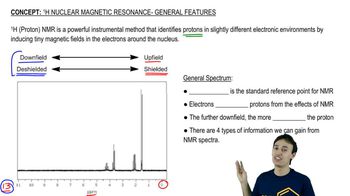
NMR spectroscopy is a powerful analytical technique used to determine the structure of organic compounds. It relies on the magnetic properties of certain nuclei, primarily hydrogen (1H) and carbon (13C), to provide information about the number of neighboring atoms and their environments. The resulting spectrum displays peaks that correspond to different chemical environments, allowing chemists to infer structural details.
Recommended video:
Guided course
10:06
General NMR Features

Spin-Spin Coupling

Spin-spin coupling, or J-coupling, occurs when the magnetic fields of neighboring nuclei influence each other, leading to the splitting of NMR signals into multiple peaks. The number of peaks and their relative intensities in a multiplet, such as a quintet, is determined by the number of neighboring protons (n) according to the n+1 rule. This concept is crucial for interpreting the complexity of NMR spectra and understanding molecular connectivity.
Recommended video:
Guided course
02:54
Sonogashira Coupling Reaction

Relative Peak Intensities

In NMR spectroscopy, the relative intensities of peaks in a multiplet provide insight into the number of equivalent protons contributing to each signal. For a quintet, the intensity pattern follows a binomial distribution, reflecting the probability of different spin states among neighboring protons. Understanding how to predict and calculate these intensities is essential for accurately interpreting NMR spectra and deducing structural information.
Recommended video:
Guided course
09:26
The (M + 1) Peak