Ch. 14 - NMR Spectroscopy
Bruice - Organic Chemistry 8th Edition
Bruice8th EditionOrganic ChemistryISBN: 9780135213711Not the one you use?Change textbook
Chapter 15, Problem 23a

Indicate the number of signals and the multiplicity of each signal in the 1H NMR spectrum of each of the following compounds:
a. CH3CH2CH2CH2CH2CH3

Verified step by step guidance
1
Step 1: Analyze the structure of the compound CH3CH2CH2CH2CH2CH3. This is a straight-chain alkane with six carbon atoms, also known as hexane. Each carbon is bonded to hydrogens in a specific environment, which determines the number of unique proton signals in the 1H NMR spectrum.
Step 2: Identify the symmetry in the molecule. Hexane is a symmetrical molecule, meaning that equivalent groups of protons will produce the same signal in the 1H NMR spectrum. Specifically, the two terminal CH3 groups are equivalent, and the internal CH2 groups are also equivalent.
Step 3: Determine the number of unique proton environments. In hexane, there are two unique environments: (1) the protons in the CH3 groups and (2) the protons in the CH2 groups. This means there will be two distinct signals in the 1H NMR spectrum.
Step 4: Predict the multiplicity of each signal. The multiplicity of a signal is determined by the number of neighboring protons (n) using the n+1 rule: (1) The CH3 protons are adjacent to CH2 protons, so their signal will be a triplet (n=2, n+1=3). (2) The CH2 protons are adjacent to CH3 and CH2 groups, so their signal will be a multiplet (due to multiple neighboring protons).
Step 5: Summarize the findings. The 1H NMR spectrum of hexane will have two signals: one triplet for the CH3 protons and one multiplet for the CH2 protons. The relative integration of the signals will reflect the ratio of CH3 to CH2 protons in the molecule.

Verified video answer for a similar problem:

This video solution was recommended by our tutors as helpful for the problem above.
Video duration:
7m
Was this helpful?

Key Concepts

Here are the essential concepts you must grasp in order to answer the question correctly.

Nuclear Magnetic Resonance (NMR) Spectroscopy

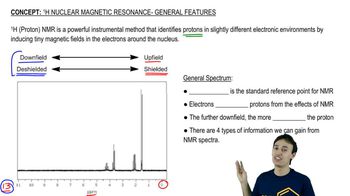
NMR spectroscopy is a powerful analytical technique used to determine the structure of organic compounds. It exploits the magnetic properties of certain nuclei, primarily hydrogen (1H), to provide information about the number of hydrogen atoms in different environments within a molecule. The resulting spectrum displays signals that correspond to these environments, allowing chemists to infer structural details.
Recommended video:
Guided course
10:06
General NMR Features

Chemical Shift

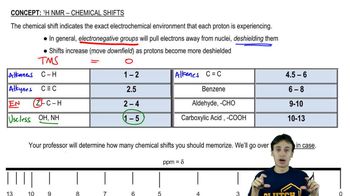
The chemical shift in NMR refers to the position of a signal in the spectrum, which indicates the electronic environment surrounding the hydrogen atoms. Different functional groups and molecular structures influence the chemical shift, causing signals to appear at varying frequencies. Understanding chemical shifts is crucial for interpreting the NMR spectrum and identifying the types of hydrogen present in a compound.
Recommended video:
Guided course
11:44
1H NMR Chemical Shifts

Multiplicity

Multiplicity in NMR refers to the splitting of a signal into multiple peaks, which occurs due to spin-spin coupling between neighboring hydrogen atoms. The number of peaks is determined by the n+1 rule, where n is the number of adjacent hydrogen atoms. This concept helps in understanding the connectivity and arrangement of hydrogen atoms in a molecule, providing insights into its structure.
Recommended video:
1:41
Primary Structure of Nucleic Acids Concept 1