Textbook Question
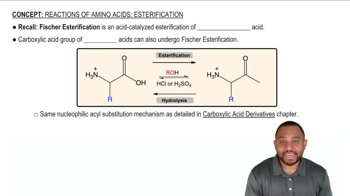
a. When a carboxylic acid is dissolved in isotopically labeled water (H2O18) and an acid catalyst is added, the label is incorporated into both oxygens of the acid. Propose a mechanism to account for this.
1049
views

 Bruice 8th EditionCh. 15 - Reactions of Carboxylic Acids and Carboxylic Acid DerivativesProblem 78
 Verified step by step guidance
 1:21
1:21
 02:53
02:53 01:17
01:17a. When a carboxylic acid is dissolved in isotopically labeled water (H2O18) and an acid catalyst is added, the label is incorporated into both oxygens of the acid. Propose a mechanism to account for this.
An aqueous solution of a primary or secondary amine reacts with an acyl chloride to form an amide as the major product. However, if the amine is tertiary, an amide is not formed. What product is formed? Explain.
a. When a carboxylic acid is dissolved in isotopically labeled water (H2O18) and an acid catalyst is added, the label is incorporated into both oxygens of the acid. Propose a mechanism to account for this.
c. If an ester is dissolved in isotopically labeled water (H2O18) and an acid catalyst is added, where will the label reside in the product?
Identify the major and minor products of the following reaction:
When a compound with molecular formula C11H14O2 undergoes acid-catalyzed hydrolysis, one of the products that is isolated gives the following 1H NMR spectrum. Identify the compound.
Cardura, a drug used to treat hypertension, is synthesized as shown here.
a. Identify the intermediate (A) and show the mechanism for its formation.