Ch. 15 - Reactions of Carboxylic Acids and Carboxylic Acid Derivatives
Bruice - Organic Chemistry 8th Edition
Bruice8th EditionOrganic ChemistryISBN: 9780135213711Not the one you use?Change textbook
Chapter 16, Problem 77a,c

a. When a carboxylic acid is dissolved in isotopically labeled water (H2O18) and an acid catalyst is added, the label is incorporated into both oxygens of the acid. Propose a mechanism to account for this.
Chemical reaction showing acid-catalyzed ester hydrolysis with isotopically labeled water, highlighting oxygen labeling.
c. If an ester is dissolved in isotopically labeled water (H2O18) and an acid catalyst is added, where will the label reside in the product?

Verified step by step guidance
1
Step 1: Understand the reaction mechanism for the carboxylic acid in isotopically labeled water (H2O18). The incorporation of the isotopic label into both oxygens of the carboxylic acid occurs due to the reversible nature of the acid-catalyzed hydration and exchange reactions. The carboxylic acid undergoes protonation on the carbonyl oxygen, making the carbonyl carbon more electrophilic.
Step 2: After protonation, the carbonyl group reacts with the isotopically labeled water (H2O18), leading to the formation of a tetrahedral intermediate. This intermediate can collapse back to regenerate the carboxylic acid, but during this process, the labeled oxygen from H2O18 can replace the original oxygen in the hydroxyl group.
Step 3: The process is reversible, and repeated exchanges between the labeled water and the carboxylic acid result in the incorporation of the isotopic label (O18) into both the hydroxyl oxygen and the carbonyl oxygen of the carboxylic acid. This is due to the equilibrium established in the reaction.
Step 4: For the ester in isotopically labeled water (H2O18) with an acid catalyst, the reaction mechanism involves acid-catalyzed hydrolysis. The ester is protonated on the carbonyl oxygen, making the carbonyl carbon more electrophilic. This allows the isotopically labeled water to attack the carbonyl carbon, forming a tetrahedral intermediate.
Step 5: The tetrahedral intermediate collapses, leading to the cleavage of the ester bond and the formation of a carboxylic acid and an alcohol. The isotopic label (O18) will reside in the hydroxyl group of the carboxylic acid product, as the labeled water contributes its oxygen during the hydrolysis process.

Verified video answer for a similar problem:

This video solution was recommended by our tutors as helpful for the problem above.
Was this helpful?

Key Concepts

Here are the essential concepts you must grasp in order to answer the question correctly.

Carboxylic Acid Reactivity

Carboxylic acids are organic compounds characterized by the presence of a carboxyl group (-COOH). They can undergo various reactions, including hydration and esterification. In the presence of an acid catalyst, the carboxylic acid can interact with water, leading to the incorporation of water's isotopes into the acid structure, particularly affecting the oxygen atoms.
Recommended video:
Guided course
04:20
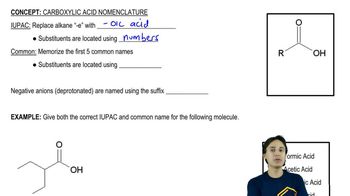
Carboxylic Acids Nomenclature

Mechanism of Acid-Catalyzed Reactions

Acid-catalyzed reactions often involve the protonation of a reactant, which increases its electrophilicity. In the case of carboxylic acids and esters, the acid catalyst facilitates the formation of a more reactive intermediate, allowing for the incorporation of isotopically labeled water. Understanding this mechanism is crucial for predicting where the label will end up in the product.
Recommended video:
Guided course
06:34
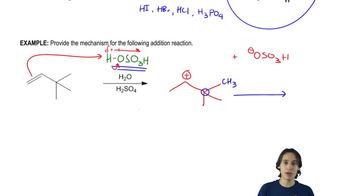
Acid-catalyzed hydration mechanism

Isotopic Labeling in Organic Chemistry

Isotopic labeling involves substituting a stable isotope, such as oxygen-18, into a molecule to trace its behavior in chemical reactions. In the context of the question, when an ester reacts with isotopically labeled water, the location of the label in the product can be determined by analyzing the reaction mechanism and the positions of the oxygen atoms in the reactants and products.
Recommended video:
Guided course
00:56
What is an organic molecule?