Ch. 15 - Reactions of Carboxylic Acids and Carboxylic Acid Derivatives
Bruice - Organic Chemistry 8th Edition
Bruice8th EditionOrganic ChemistryISBN: 9780135213711Not the one you use?Change textbook
Chapter 16, Problem 64

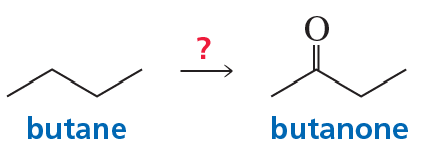
Describe how the target molecule (butanone) can be synthesized in a high yield from butane.
Synthesis of butanone from butane, showing the molecular structures and reaction arrow.

Verified step by step guidance
1
Step 1: Begin by understanding the transformation required. The target molecule, butanone (CH3COCH2CH3), is a ketone, while the starting material, butane (C4H10), is an alkane. This means the process will involve oxidation to introduce a carbonyl group.
Step 2: Perform a controlled oxidation of butane. First, convert butane into butanol (an alcohol) by reacting it with oxygen in the presence of a catalyst, such as cobalt or manganese-based catalysts. This step is crucial to introduce a functional group that can be further oxidized.
Step 3: Oxidize the butanol to butanal (an aldehyde). This can be achieved using a mild oxidizing agent such as PCC (Pyridinium chlorochromate) or by carefully controlling the reaction conditions with stronger oxidizing agents like KMnO4 or CrO3.
Step 4: Further oxidize butanal to butanone. This step involves converting the aldehyde group (-CHO) into a ketone group (-CO-). A strong oxidizing agent such as potassium dichromate (K2Cr2O7) in acidic conditions can be used for this transformation.
Step 5: Ensure high yield by carefully controlling reaction conditions at each step. For example, avoid over-oxidation of butanone to carboxylic acids by monitoring the reaction time and using appropriate catalysts. Purify the final product using distillation or other separation techniques.

Verified video answer for a similar problem:

This video solution was recommended by our tutors as helpful for the problem above.
Video duration:
7m
Was this helpful?

Key Concepts

Here are the essential concepts you must grasp in order to answer the question correctly.

Hydrocarbon Functional Groups

Understanding the functional groups in hydrocarbons is essential for organic synthesis. Butane is an alkane, characterized by single bonds between carbon atoms, while butanone is a ketone, which contains a carbonyl group (C=O) flanked by two carbon atoms. Recognizing these functional groups helps in determining the necessary reactions to convert butane into butanone.
Recommended video:
Guided course
02:36
Identifying Functional Groups

Oxidation Reactions

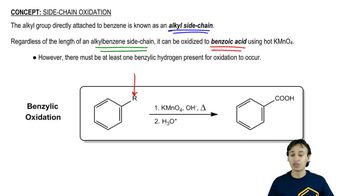
Oxidation reactions involve the loss of electrons or an increase in oxidation state, which is crucial for converting alkanes to ketones. In the case of butane to butanone, a common method is the oxidation of butane using reagents like potassium permanganate or chromic acid, which facilitates the transformation of the alkane into the corresponding ketone while maximizing yield.
Recommended video:
Guided course
03:20
Benzylic Oxidation

Reaction Conditions and Yield

The conditions under which a reaction occurs significantly affect the yield of the desired product. Factors such as temperature, pressure, and the presence of catalysts can influence the efficiency of the oxidation process. Optimizing these conditions is vital for achieving a high yield of butanone from butane, ensuring that side reactions are minimized and the desired product is favored.
Recommended video:
Guided course
04:37
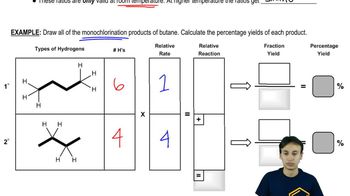
Draw all of the monochlorination products and calculate percentage yields.