Ch. 15 - Reactions of Carboxylic Acids and Carboxylic Acid Derivatives
Bruice - Organic Chemistry 8th Edition
Bruice8th EditionOrganic ChemistryISBN: 9780135213711Not the one you use?Change textbook
Chapter 16, Problem 68c

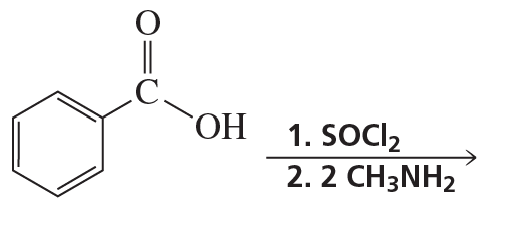
What are the products of the following reactions?
c. Chemical structure of a carboxylic acid with reaction steps to form an acid chloride using SOCl2 and methylamine.

Verified step by step guidance
1
Step 1: Analyze the starting material. The given compound is a cyclopentane ring with a carboxylic acid group (-COOH) attached to it.
Step 2: Understand the role of SOCl2 (thionyl chloride). SOCl2 reacts with carboxylic acids to convert the -COOH group into an acyl chloride (-COCl). This reaction involves the replacement of the hydroxyl group (-OH) in the carboxylic acid with a chlorine atom.
Step 3: Examine the second reagent, CH3CH2NH2 (ethylamine). Acyl chlorides are highly reactive and can undergo nucleophilic substitution with amines. In this case, the ethylamine will attack the acyl chloride, replacing the chlorine atom and forming an amide bond (-CONH-).
Step 4: Combine the transformations. The first step converts the carboxylic acid into an acyl chloride, and the second step converts the acyl chloride into an amide. The final product will be a cyclopentane ring with an amide group (-CONHCH2CH3) attached.
Step 5: Verify the structure of the product. The product is N-ethylcyclopentanecarboxamide, where the amide group is directly attached to the cyclopentane ring.

Verified video answer for a similar problem:

This video solution was recommended by our tutors as helpful for the problem above.
Video duration:
3m
Was this helpful?

Key Concepts

Here are the essential concepts you must grasp in order to answer the question correctly.

Carboxylic Acids

Carboxylic acids are organic compounds characterized by the presence of a carboxyl group (-COOH). They are known for their acidic properties and can undergo various chemical reactions, including conversion to acid chlorides. Understanding their structure and reactivity is essential for predicting the products of reactions involving them.
Recommended video:
Guided course
04:20
Carboxylic Acids Nomenclature

Thionyl Chloride (SOCl2)

Thionyl chloride (SOCl2) is a reagent commonly used to convert carboxylic acids into acid chlorides. This reaction involves the substitution of the hydroxyl group (-OH) of the carboxylic acid with a chlorine atom, resulting in the formation of an acid chloride. This step is crucial in the reaction sequence provided in the question.
Recommended video:
Guided course
07:18
Learning the mechanism of SOCl2.

Amine Nucleophiles

Amines, such as methylamine (CH3NH2), act as nucleophiles in organic reactions. They can react with acid chlorides to form amides through nucleophilic acyl substitution. Understanding the role of amines in these reactions is vital for predicting the final products when they react with acid chlorides.
Recommended video:
Guided course
07:12
Reductive Amination