Ch. 15 - Reactions of Carboxylic Acids and Carboxylic Acid Derivatives
Bruice - Organic Chemistry 8th Edition
Bruice8th EditionOrganic ChemistryISBN: 9780135213711Not the one you use?Change textbook
Chapter 16, Problem 48c,k

Draw a structure for each of the following:
c. cyclohexanecarbonyl chloride
k. benzoyl chloride

Verified step by step guidance
1
Step 1: Understand the functional group 'carbonyl chloride'. It consists of a carbon atom double-bonded to an oxygen atom (C=O) and single-bonded to a chlorine atom (Cl). This group is also known as an acyl chloride.
Step 2: For 'cyclohexanecarbonyl chloride', start with the cyclohexane ring, which is a six-membered ring of carbon atoms. Attach the carbonyl chloride group (-COCl) to one of the carbons in the ring. This forms cyclohexanecarbonyl chloride.
Step 3: For 'benzoyl chloride', begin with a benzene ring, which is a six-membered aromatic ring with alternating double bonds. Attach the carbonyl chloride group (-COCl) to one of the carbons in the benzene ring. This forms benzoyl chloride.
Step 4: Verify the structures by ensuring that the carbonyl chloride group is correctly attached to the respective rings and that all valencies of carbon atoms are satisfied.
Step 5: Draw the final structures for both compounds, ensuring clarity in the representation of the cyclohexane ring, benzene ring, and the carbonyl chloride group.

Verified video answer for a similar problem:

This video solution was recommended by our tutors as helpful for the problem above.
Video duration:
1m
Was this helpful?

Key Concepts

Here are the essential concepts you must grasp in order to answer the question correctly.

Functional Groups

Functional groups are specific groups of atoms within molecules that are responsible for the characteristic chemical reactions of those molecules. In the case of cyclohexanecarbonyl chloride and benzoyl chloride, the carbonyl group (C=O) and the chloride (Cl) are key functional groups that influence the reactivity and properties of these compounds.
Recommended video:
Guided course
02:36
Identifying Functional Groups

Cyclohexane Structure

Cyclohexane is a six-membered carbon ring with the molecular formula C6H12. Its structure can adopt various conformations, such as chair and boat forms, which affect the spatial arrangement of substituents. Understanding the cyclohexane framework is essential for drawing cyclohexanecarbonyl chloride accurately, as the carbonyl group will be attached to one of the carbons in the ring.
Recommended video:
Guided course
03:04
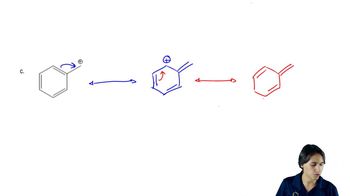
Drawing Resonance Structures

Aromatic Compounds

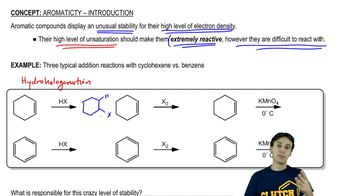
Aromatic compounds, like benzoyl chloride, contain a benzene ring, which is characterized by its stable ring structure and delocalized π electrons. The presence of the carbonyl group attached to the benzene ring in benzoyl chloride significantly affects its chemical behavior, making it an important compound in organic synthesis and reactions involving electrophiles.
Recommended video:
Guided course
08:19
Intro to Aromaticity