Ch. 15 - Reactions of Carboxylic Acids and Carboxylic Acid Derivatives
Bruice - Organic Chemistry 8th Edition
Bruice8th EditionOrganic ChemistryISBN: 9780135213711Not the one you use?Change textbook
Chapter 16, Problem 48g

Draw a structure for each of the following:
g. benzoic anhydride

Verified step by step guidance
1
Step 1: Understand the structure of benzoic acid. Benzoic acid is an aromatic carboxylic acid with the formula C₆H₅COOH. It consists of a benzene ring (C₆H₅) attached to a carboxylic acid group (-COOH).
Step 2: Recall the structure of an anhydride. An anhydride is formed by the condensation of two carboxylic acid molecules, where a water molecule is removed. The general structure of an anhydride is R-CO-O-CO-R, where R represents the organic groups.
Step 3: Combine two benzoic acid molecules to form benzoic anhydride. Remove one molecule of water (H₂O) by eliminating an -OH group from one benzoic acid molecule and an -H from the other. This results in the formation of a bond between the two carbonyl groups through an oxygen atom.
Step 4: Draw the structure of benzoic anhydride. The structure will have two benzene rings (C₆H₅) attached to a central anhydride group (-CO-O-CO-). Each benzene ring is connected to a carbonyl group (C=O).
Step 5: Verify the structure. Ensure that the central oxygen atom is bonded to two carbonyl groups, and each carbonyl group is attached to a benzene ring. This confirms the correct structure of benzoic anhydride.

Verified video answer for a similar problem:

This video solution was recommended by our tutors as helpful for the problem above.
Video duration:
3m
Was this helpful?

Key Concepts

Here are the essential concepts you must grasp in order to answer the question correctly.

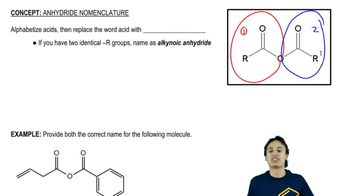
Anhydrides

Anhydrides are compounds formed from the removal of water from two carboxylic acids. They can be classified as either symmetric or asymmetric, depending on whether the two acids are the same or different. In organic chemistry, anhydrides are important for various reactions, including acylation, where they can react with nucleophiles to form esters or amides.
Recommended video:
Guided course
03:35
Anhydride Nomenclature

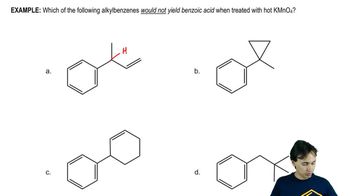
Benzoic Acid

Benzoic acid is a simple aromatic carboxylic acid with the formula C6H5COOH. It consists of a benzene ring attached to a carboxyl group (-COOH). Understanding benzoic acid is crucial for drawing benzoic anhydride, as the anhydride is derived from two benzoic acid molecules through the loss of water.
Recommended video:
Guided course
00:49
Which alkylbenzene would NOT yield benzoic acid, treated with KMnO4

Structural Representation

Structural representation in organic chemistry involves depicting the arrangement of atoms within a molecule, including bonds and functional groups. For benzoic anhydride, it is essential to illustrate the two benzoic acid units connected by an anhydride bond (–C(=O)–O–C(=O)–). Mastery of structural representation aids in visualizing molecular interactions and predicting reactivity.
Recommended video:
Guided course
05:09
Representations of L-Configuration