

Ch. 15 - Reactions of Carboxylic Acids and Carboxylic Acid Derivatives
Bruice - Organic Chemistry 8th Edition
Bruice8th EditionOrganic ChemistryISBN: 9780135213711Not the one you use?Change textbook
Chapter 16, Problem 85b

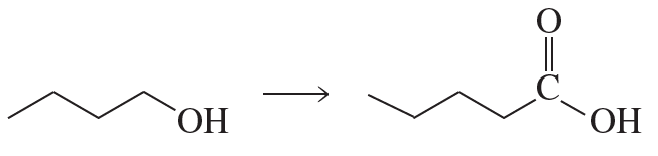
Show how the following compounds could be prepared from the given starting materials. You can use any necessary organic or inorganic reagents.
b. Reaction diagram showing the conversion of an alcohol to a carboxylic acid via acid-catalyzed ester hydrolysis.

Verified step by step guidance
1
Step 1: Identify the functional group transformation. The starting material is benzyl alcohol (C6H5CH2OH), and the target compound is phenylacetic acid (C6H5CH2COOH). This involves oxidation of the primary alcohol to a carboxylic acid.
Step 2: Choose an appropriate oxidizing agent. Common reagents for oxidizing primary alcohols to carboxylic acids include potassium permanganate (KMnO4) under acidic or basic conditions, or chromium-based reagents like Jones reagent (CrO3 in H2SO4).
Step 3: Set up the reaction conditions. For example, if using KMnO4, dissolve the alcohol in water or an appropriate solvent, add KMnO4, and heat the mixture gently to facilitate the oxidation reaction.
Step 4: Monitor the reaction progress. Use techniques like thin-layer chromatography (TLC) or infrared spectroscopy (IR) to confirm the disappearance of the alcohol functional group and the appearance of the carboxylic acid group.
Step 5: Purify the product. After the reaction is complete, isolate phenylacetic acid by acidifying the reaction mixture (if necessary), followed by extraction and recrystallization to obtain the pure compound.

Verified video answer for a similar problem:

This video solution was recommended by our tutors as helpful for the problem above.
Video duration:
1m
Was this helpful?

Key Concepts

Here are the essential concepts you must grasp in order to answer the question correctly.

Functional Groups

Functional groups are specific groups of atoms within molecules that are responsible for the characteristic chemical reactions of those molecules. In the context of the question, the presence of hydroxyl (-OH) and carbonyl (C=O) groups indicates the transformation of alcohols to carboxylic acids or their derivatives, which is essential for understanding the reactivity and synthesis of the target compounds.
Recommended video:
Guided course
02:36
Identifying Functional Groups

Oxidation Reactions

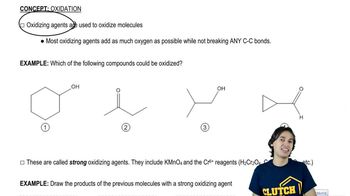
Oxidation reactions involve the loss of electrons or an increase in oxidation state by a molecule, atom, or ion. In organic chemistry, alcohols can be oxidized to aldehydes or carboxylic acids, depending on the conditions and reagents used. This concept is crucial for converting the starting alcohol into the desired carboxylic acid derivative in the question.
Recommended video:
Guided course
03:20
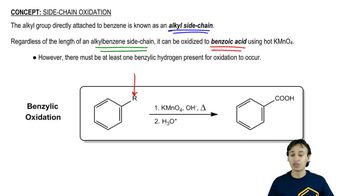
Benzylic Oxidation

Reagents and Reaction Conditions

The choice of reagents and reaction conditions is vital in organic synthesis as they dictate the pathway and outcome of a reaction. Common reagents for oxidation include potassium dichromate, PCC, or even mild oxidants like silver oxide. Understanding how to select appropriate reagents based on the desired transformation is key to successfully preparing the target compounds from the given starting materials.
Recommended video: