
Ch. 15 - Reactions of Carboxylic Acids and Carboxylic Acid Derivatives
Bruice - Organic Chemistry 8th Edition
Bruice8th EditionOrganic ChemistryISBN: 9780135213711Not the one you use?Change textbook
Chapter 16, Problem 85c

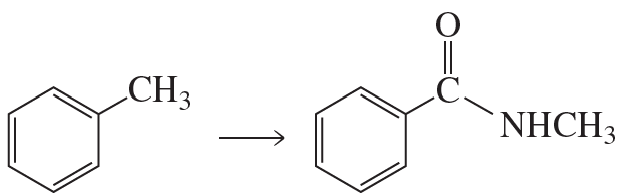
Show how the following compounds could be prepared from the given starting materials. You can use any necessary organic or inorganic reagents.
c. Chemical reaction showing the conversion of toluene to an amide derivative with a carbonyl group.

Verified step by step guidance
1
Step 1: Begin with the starting material, anisole (methoxybenzene). The first step involves introducing an acyl group onto the benzene ring via Friedel-Crafts acylation. Use an acyl chloride (e.g., ethanoyl chloride) and a Lewis acid catalyst such as AlCl₃ to form the ketone group on the benzene ring.
Step 2: After the acylation, the product will be 4-methoxyacetophenone. Next, convert the ketone group into an amide group. This can be achieved by reacting the ketone with an amine (e.g., ethylamine) in the presence of a reducing agent or activating agent such as NaBH₃CN or TiCl₄.
Step 3: Ensure the reaction conditions are controlled to favor the formation of the amide bond. This step involves nucleophilic attack by the amine on the carbonyl carbon of the ketone, followed by dehydration to form the amide.
Step 4: Verify the position of the substituents on the benzene ring. The methoxy group is an ortho/para-directing group, which ensures that the acylation occurs at the para position relative to the methoxy group.
Step 5: Purify the final product using techniques such as recrystallization or chromatography to isolate the desired compound, 4-methoxy-N-ethylbenzamide.

Verified video answer for a similar problem:

This video solution was recommended by our tutors as helpful for the problem above.
Video duration:
4m
Was this helpful?

Key Concepts

Here are the essential concepts you must grasp in order to answer the question correctly.

Carboxylation

Carboxylation is a chemical reaction that introduces a carboxyl group (-COOH) into a compound. This process is often achieved through the reaction of a carbonyl compound with carbon dioxide, typically in the presence of a catalyst. Understanding carboxylation is essential for synthesizing carboxylic acids from other organic compounds, as seen in the transformation of aromatic compounds in the provided reaction.
Recommended video:
Guided course
04:20
Carboxylic Acids Nomenclature

Aromatic Substitution Reactions

Aromatic substitution reactions involve the replacement of a hydrogen atom in an aromatic ring with another substituent. These reactions are crucial in organic chemistry as they allow for the functionalization of aromatic compounds. The mechanism often involves electrophilic aromatic substitution (EAS), where an electrophile attacks the electron-rich aromatic system, leading to the formation of new products while preserving the aromaticity of the ring.
Recommended video:
Guided course
08:19
Intro to Aromaticity

Reagents in Organic Synthesis

Reagents in organic synthesis are substances used to bring about a chemical reaction. They can include acids, bases, oxidizing agents, reducing agents, and catalysts. Selecting the appropriate reagents is vital for achieving the desired transformation efficiently and selectively. In the context of the provided reaction, understanding which reagents facilitate carboxylation and aromatic substitution is key to successfully preparing the target compound.
Recommended video:
1:16
Synthesis of Amino Acids: Strecker Synthesis Example 1