Ch. 15 - Reactions of Carboxylic Acids and Carboxylic Acid Derivatives
Bruice - Organic Chemistry 8th Edition
Bruice8th EditionOrganic ChemistryISBN: 9780135213711Not the one you use?Change textbook
Chapter 16, Problem 88

The intermediate shown here is formed during the hydroxide-ion-promoted hydrolysis of the ester group. Propose a mechanism for the reaction.
Chemical reaction diagram illustrating the hydrolysis of an ester group with hydroxide ions, showing intermediate products.

Verified step by step guidance
1
Identify the reaction type: This is a base-catalyzed hydrolysis of an ester, also known as saponification. The hydroxide ion (HO⁻) acts as a nucleophile, attacking the ester carbonyl carbon.
Step 1: Nucleophilic attack. The hydroxide ion (HO⁻) attacks the carbonyl carbon of the ester, forming a tetrahedral intermediate. Represent this step using the following mechanism: R1-C(O)OR2+HO-R1-C(OH)OR2
Step 2: Collapse of the tetrahedral intermediate. The intermediate collapses, expelling the leaving group (CF₃CH₂O⁻) and forming a carboxylic acid derivative. This step involves the reformation of the carbonyl group.
Step 3: Deprotonation of the carboxylic acid. The hydroxide ion (HO⁻) deprotonates the carboxylic acid, forming a carboxylate anion (RCOO⁻) and water (H₂O).
Step 4: Identify the products. The final products of the reaction are the carboxylate salt (RCOO⁻) and the alcohol (CF₃CH₂OH), which was the leaving group in Step 2.

Verified video answer for a similar problem:

This video solution was recommended by our tutors as helpful for the problem above.
Video duration:
9m
Was this helpful?

Key Concepts

Here are the essential concepts you must grasp in order to answer the question correctly.

Ester Hydrolysis

Ester hydrolysis is a chemical reaction where an ester reacts with water to form an alcohol and a carboxylic acid. In the presence of a base, such as hydroxide ion (OH-), the reaction proceeds via nucleophilic attack on the carbonyl carbon of the ester, leading to the formation of a tetrahedral intermediate. This intermediate then collapses to yield the products, typically an alcohol and a carboxylate ion.
Recommended video:
0:48
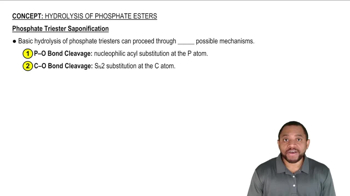
Hydrolysis of Phosphate Esters Concept 2

Nucleophilic Attack

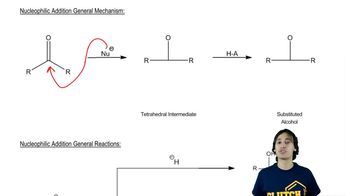
Nucleophilic attack is a fundamental concept in organic chemistry where a nucleophile, which is an electron-rich species, attacks an electron-deficient atom, usually carbon. In the context of ester hydrolysis, the hydroxide ion acts as the nucleophile, attacking the carbonyl carbon of the ester. This step is crucial as it initiates the reaction mechanism and leads to the formation of the tetrahedral intermediate.
Recommended video:
Guided course
08:27
Nucleophilic Addition

Tetrahedral Intermediate

A tetrahedral intermediate is a transient species formed during reactions involving carbonyl compounds, where the carbon atom becomes sp3 hybridized. In ester hydrolysis, the nucleophilic attack by hydroxide ion results in the formation of this intermediate, which is characterized by a tetrahedral geometry around the carbon atom. The stability and subsequent breakdown of this intermediate are key to understanding the overall reaction mechanism.
Recommended video:
Guided course
04:31
Stability of Conjugated Intermediates