Ch. 16 - Reactions of Aldehydes and Ketones • More Reactions of Carboxylic Acid Derivatives
Bruice - Organic Chemistry 8th Edition
Bruice8th EditionOrganic ChemistryISBN: 9780135213711Not the one you use?Change textbook
Chapter 17, Problem 83

A compound gives the following IR spectrum. Upon reaction with sodium borohydride followed by acidification, it forms the product with the 1H NMR spectrum shown below. Identify the starting material and the product.
<IMAGE>

Verified step by step guidance
1
Analyze the IR spectrum to identify key functional groups. Look for characteristic absorption bands, such as a strong peak around 1700 cm⁻¹ (indicative of a carbonyl group) or a broad peak around 3200-3600 cm⁻¹ (indicative of an -OH group).
Determine the type of reaction occurring with sodium borohydride (NaBH₄). Sodium borohydride is a reducing agent that typically reduces aldehydes and ketones to their corresponding alcohols. This suggests the starting material likely contains a carbonyl group.
Examine the 1H NMR spectrum of the product. Look for signals that indicate the presence of alcohol protons (e.g., a singlet around 1-5 ppm for an -OH group) and other characteristic proton environments. Compare these signals to the expected product of the reduction reaction.
Propose the structure of the starting material based on the IR spectrum and the reaction mechanism. If the IR spectrum shows a strong carbonyl peak (e.g., around 1700 cm⁻¹), the starting material is likely an aldehyde or ketone.
Propose the structure of the product based on the 1H NMR spectrum and the reaction mechanism. The product should correspond to the alcohol formed by the reduction of the starting material's carbonyl group.

Verified video answer for a similar problem:

This video solution was recommended by our tutors as helpful for the problem above.
Was this helpful?

Key Concepts

Here are the essential concepts you must grasp in order to answer the question correctly.

Infrared (IR) Spectroscopy

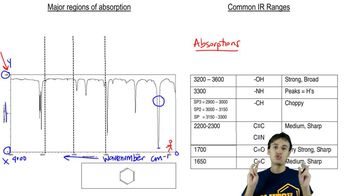
IR spectroscopy is a technique used to identify functional groups in organic compounds by measuring the absorption of infrared light. Different bonds absorb characteristic wavelengths, allowing chemists to deduce the presence of specific functional groups, such as alcohols, carbonyls, or amines, based on the peaks observed in the spectrum.
Recommended video:
Guided course
16:04
General Features of IR Spect

Sodium Borohydride Reduction

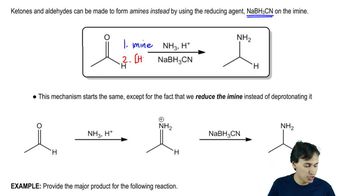
Sodium borohydride (NaBH4) is a reducing agent commonly used to convert carbonyl compounds, such as aldehydes and ketones, into their corresponding alcohols. This reaction typically involves the nucleophilic attack of the hydride ion on the carbonyl carbon, leading to the formation of an alcohol after subsequent acidification, which can be crucial for identifying the product in the given question.
Recommended video:
Guided course
07:12
Reductive Amination

Proton Nuclear Magnetic Resonance (1H NMR) Spectroscopy

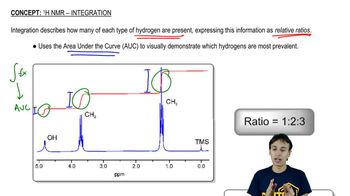
1H NMR spectroscopy is a powerful analytical technique used to determine the structure of organic compounds by analyzing the magnetic environment of hydrogen atoms. The chemical shifts, splitting patterns, and integration of peaks in the NMR spectrum provide insights into the number of hydrogen atoms, their connectivity, and the presence of functional groups, aiding in the identification of both the starting material and the product.
Recommended video:
Guided course
06:46
1H NMR Integration