Ch. 16 - Reactions of Aldehydes and Ketones • More Reactions of Carboxylic Acid Derivatives
Bruice - Organic Chemistry 8th Edition
Bruice8th EditionOrganic ChemistryISBN: 9780135213711Not the one you use?Change textbook
Chapter 17, Problem 80

Propose a mechanism to explain how dimethyl sulfoxide and oxalyl chloride react to form the dimethylchlorosulfonium ion used as the oxidizing agent in the Swern oxidation.
Reaction mechanism showing dimethyl sulfoxide and oxalyl chloride forming dimethylchlorosulfonium ion as an oxidizing agent.

Verified step by step guidance
1
Step 1: Begin by recognizing that dimethyl sulfoxide (DMSO) acts as a nucleophile due to the lone pair on the sulfur atom. Oxalyl chloride, a reactive electrophile, reacts with DMSO by allowing the sulfur atom to attack one of the carbonyl carbons of oxalyl chloride, leading to the formation of a tetrahedral intermediate.
Step 2: The tetrahedral intermediate collapses, expelling a molecule of carbon dioxide (CO₂) and a molecule of carbon monoxide (CO). This results in the formation of a chlorodimethylsulfonium ion, where the sulfur atom is now positively charged and bonded to a chlorine atom.
Step 3: The chlorodimethylsulfonium ion is highly electrophilic and serves as the oxidizing agent in the Swern oxidation. It reacts with the alcohol substrate (e.g., propan-2-ol) by facilitating the formation of an alkoxysulfonium intermediate.
Step 4: Triethylamine, a base, is introduced to deprotonate the alkoxysulfonium intermediate, leading to the formation of a ketone (e.g., acetone) and dimethyl sulfide as the final products.
Step 5: The overall reaction mechanism highlights the role of dimethyl sulfoxide and oxalyl chloride in generating the reactive chlorodimethylsulfonium ion, which is essential for the oxidation of alcohols to carbonyl compounds in the Swern oxidation.

Verified video answer for a similar problem:

This video solution was recommended by our tutors as helpful for the problem above.
Video duration:
4m
Was this helpful?

Key Concepts

Here are the essential concepts you must grasp in order to answer the question correctly.

Swern Oxidation

Swern oxidation is a method for converting alcohols into carbonyl compounds using dimethyl sulfoxide (DMSO) and an activating agent, typically oxalyl chloride. The process involves the formation of a chlorosulfide intermediate, which subsequently reacts with the alcohol to yield the desired carbonyl compound. This reaction is notable for its mild conditions and high selectivity.
Recommended video:
Guided course
03:40
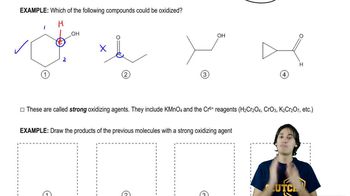
Strong oxidizing agents

Dimethyl Sulfoxide (DMSO)

Dimethyl sulfoxide is a polar aprotic solvent widely used in organic synthesis. It acts as a reagent in various reactions, including the Swern oxidation, where it facilitates the formation of reactive intermediates. DMSO can stabilize positive charges, making it effective in promoting nucleophilic attacks and enhancing reaction rates.
Recommended video:
Guided course
03:51
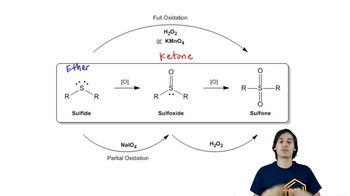
Reagents used to oxidize Sulfides.

Chlorodimethylsulfonium Ion

The chlorodimethylsulfonium ion is a key intermediate in the Swern oxidation mechanism. It is formed when DMSO reacts with oxalyl chloride, resulting in a sulfonium ion that can act as an electrophile. This ion is crucial for the subsequent reaction with alcohols, leading to the formation of the oxidizing agent, dimethylchlorosulfonium, which facilitates the oxidation process.
Recommended video:
3:39
Metal Ion Catalysis Concept 1