Ch. 16 - Reactions of Aldehydes and Ketones • More Reactions of Carboxylic Acid Derivatives
Bruice - Organic Chemistry 8th Edition
Bruice8th EditionOrganic ChemistryISBN: 9780135213711Not the one you use?Change textbook
Chapter 17, Problem 42a

What would have been the product of the preceding reaction with LiAlH4 if the keto group had not been protected?
<IMAGE>

Verified step by step guidance
1
Step 1: Analyze the structure of the reactant. The molecule contains two functional groups: a ketone group (C=O) and an ester group (COOCH3). Both groups are susceptible to reduction by LiAlH4.
Step 2: Understand the reactivity of LiAlH4. Lithium aluminum hydride (LiAlH4) is a strong reducing agent that can reduce both ketones and esters to their corresponding alcohols.
Step 3: Predict the reduction of the ketone group. If the keto group is not protected, LiAlH4 will reduce the ketone (C=O) to a secondary alcohol (CH-OH). This occurs because the hydride ion (H-) from LiAlH4 attacks the carbonyl carbon of the ketone.
Step 4: Predict the reduction of the ester group. LiAlH4 will also reduce the ester group (COOCH3) to a primary alcohol. The ester undergoes nucleophilic attack by the hydride ion, leading to the formation of an aldehyde intermediate, which is further reduced to a primary alcohol.
Step 5: Combine the results. If the keto group is not protected, the final product will contain a secondary alcohol derived from the ketone and a primary alcohol derived from the ester. The reaction is completed by the addition of H3O+ in the second step to protonate the oxygen atoms and stabilize the alcohols.

Verified video answer for a similar problem:

This video solution was recommended by our tutors as helpful for the problem above.
Video duration:
5m
Was this helpful?

Key Concepts

Here are the essential concepts you must grasp in order to answer the question correctly.

Reduction Reactions

Reduction reactions involve the gain of electrons or the decrease in oxidation state by a molecule. In organic chemistry, this often refers to the conversion of carbonyl groups (like ketones and aldehydes) to alcohols. Lithium aluminum hydride (LiAlH4) is a strong reducing agent that can effectively reduce ketones to secondary alcohols, making it crucial to understand its reactivity in organic synthesis.
Recommended video:
Guided course
07:12
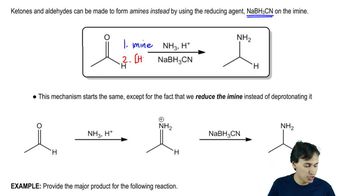
Reductive Amination

Protecting Groups

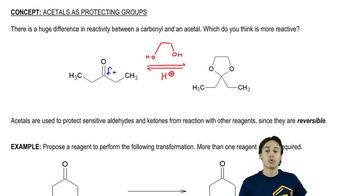
Protecting groups are temporary modifications used to shield reactive functional groups during a chemical reaction. In the context of the question, protecting the keto group prevents it from being reduced by LiAlH4, allowing for selective reactions to occur without unwanted side reactions. Understanding how and when to use protecting groups is essential for controlling the outcome of multi-step organic syntheses.
Recommended video:
Guided course
02:44
Protecting Groups

Hydrolysis of Alkoxides

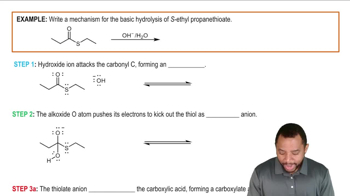
After reduction with LiAlH4, the resulting alkoxide intermediate must be converted to the corresponding alcohol. This is typically achieved through hydrolysis, where water (or an acid like H3O+) is used to protonate the alkoxide, yielding the alcohol. Recognizing the importance of this step is vital for predicting the final products of reduction reactions involving carbonyl compounds.
Recommended video:
3:09
Hydrolysis of Thioesters Example 2