Ch. 16 - Reactions of Aldehydes and Ketones • More Reactions of Carboxylic Acid Derivatives
Bruice - Organic Chemistry 8th Edition
Bruice8th EditionOrganic ChemistryISBN: 9780135213711Not the one you use?Change textbook
Chapter 17, Problem 40c

Can the rate of hydrate formation be increased by hydroxide ion as well as by acid? Explain.

Verified step by step guidance
1
Understand the context: Hydrate formation typically involves the addition of water to a carbonyl compound (e.g., aldehyde or ketone) to form a geminal diol. The reaction can be catalyzed by acids or bases, which affect the reaction mechanism differently.
Analyze the role of hydroxide ion: Hydroxide ion (OH⁻) acts as a base and can increase the rate of hydrate formation by nucleophilic attack. The hydroxide ion attacks the electrophilic carbonyl carbon, forming a tetrahedral intermediate.
Compare with acid catalysis: In acid-catalyzed hydrate formation, a proton (H⁺) increases the electrophilicity of the carbonyl carbon by protonating the oxygen atom of the carbonyl group. This makes the carbonyl carbon more susceptible to nucleophilic attack by water.
Explain the mechanism for hydroxide ion catalysis: In the base-catalyzed mechanism, the hydroxide ion directly attacks the carbonyl carbon, forming a negatively charged intermediate. This intermediate then reacts with water to form the hydrate (geminal diol).
Conclude: Yes, the rate of hydrate formation can be increased by hydroxide ion as well as by acid, but the mechanisms differ. Acid catalysis increases the electrophilicity of the carbonyl carbon, while base catalysis provides a strong nucleophile (OH⁻) to initiate the reaction.

Verified video answer for a similar problem:

This video solution was recommended by our tutors as helpful for the problem above.
Video duration:
3m
Was this helpful?

Key Concepts

Here are the essential concepts you must grasp in order to answer the question correctly.

Hydrate Formation

Hydrate formation refers to the process where water molecules bond with a solute, often resulting in a solid compound. This process is crucial in various chemical reactions, particularly in organic chemistry, where the presence of water can significantly influence the reaction pathway and product stability.
Recommended video:
Guided course
09:11
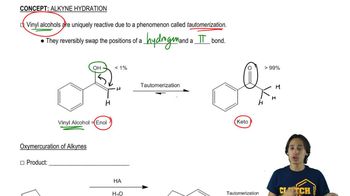
Alkyne Hydration

Role of Hydroxide Ions

Hydroxide ions (OH-) can act as nucleophiles in chemical reactions, facilitating the formation of hydrates by attacking electrophilic centers in the solute. Their basic nature can also help stabilize transition states, potentially increasing the rate of hydrate formation by promoting the reaction through a different mechanism.
Recommended video:
3:39
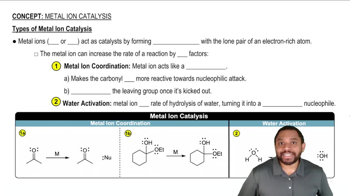
Metal Ion Catalysis Concept 1

Acid Catalysis

Acid catalysis involves the use of protons (H+) to enhance the rate of a chemical reaction. In the context of hydrate formation, acids can protonate certain functional groups, making them more reactive and thus accelerating the formation of hydrates. This dual role of acids in both stabilizing intermediates and increasing reactivity is essential for understanding reaction kinetics.
Recommended video:
2:50
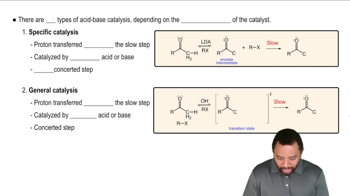
Acid-Base Catalysis Concept 3